


Cross-border workers in Switzerland: how do you complete your tax return in France?
- In which country (or countries) do you have to pay tax when you work in Switzerland?
- In which cases do you need to provide a certificate of tax residence?
- What are the deadlines for filing your tax return?
- What documents do you need to prepare to complete your tax return correctly?
- The b-sharpe guide to completing your tax return in France
- Which EUR/CHF exchange rate should you use for your tax return?
- Which bank accounts do you need to declare?
- Conclusion
Are you a cross-border worker who needs to declare your income? Check out our guide to completing your tax return in France from start to finish.
• A Franco-Swiss tax treaty prevents double taxation, but the rules vary depending on the cross-border worker's canton of employment.
• Workers in the canton of Geneva pay their taxes in Switzerland (withholding tax), while those in the cantons of Vaud, Valais, Jura, Neuchâtel, Basel, Bern or Solothurn are taxed in France, their country of residence.
• b-sharpe recommends using a fiduciary firm to complete your tax return, as this falls outside its own area of advice.

- In which country (or countries) do you have to pay tax when you work in Switzerland?
- In which cases do you need to provide a certificate of tax residence?
- What are the deadlines for filing your tax return?
- What documents do you need to prepare to complete your tax return correctly?
- The b-sharpe guide to completing your tax return in France
- Which EUR/CHF exchange rate should you use for your tax return?
- Which bank accounts do you need to declare?
- Conclusion
- Important notice: the information in this article is provided for information purposes only. b-sharpe is an online currency exchange service, and our teams are not able to help you complete your tax return. For this, we suggest contacting an accountant. Thank you for your understanding.
Update: 2020 tax return for 2019 income.
For French residents, the filing period for last year’s tax return is already here. Residents of Switzerland with income from French sources, and French residents working in Switzerland whose main home is in France, will also need to file a tax return. If you’re wondering how to complete your tax return in France, this article is for you. Discover our practical guide to help employees working in Switzerland (cantons of Geneva, Vaud, Valais, Basel, Zurich, etc.) file their tax return in France.
In which country (or countries) do you have to pay tax when you work in Switzerland?
To start with, there is a tax treaty between Switzerland and France that governs how cross-border workers are taxed in each of the two countries, with a number of precise rules designed to avoid double taxation.
In short, it is not possible for the same income to be taxed in both Switzerland and France. However, depending on the canton in which you work, the tax rules and principles of taxation differ.
| Situation | Where tax is paid | Comments |
|---|---|---|
| Case 1: Person working in the canton of Geneva and returning home every day | Switzerland | These workers pay their taxes in Switzerland and are subject to withholding tax there (the tax is deducted by the Geneva-based company directly from the salary every month and paid by the company to the cantonal tax authorities). |
| Case 2: Person working in the canton of Vaud, Valais, Jura, Neuchâtel, Basel-Stadt, Basel-Landschaft, Bern or Solothurn and returning home every day | France | A tax agreement signed between France and these cantons stipulates that people working in Switzerland and living in France are taxed in their country of residence, France. |
| Case 3: People working in other cantons (Zurich, St. Gallen, Aargau, etc.) and returning home every day | Switzerland | – |
| Case 4: Person working in any canton and returning home once a week | Switzerland | People who live in Switzerland during the week (weekly cross-border commuters) are always subject to withholding tax in Switzerland, whatever the canton. |
Please note, however, that if you had income from French sources during the year (for example if you started working during the year, or if one spouse works in France), you may be taxed in both countries, but not on the same income.
In concrete terms, this means that the tax household of a person who works in Switzerland and lives in France can either pay tax solely in Switzerland, solely in France, or in both countries.
In which cases do you need to provide a certificate of tax residence?
The certificate of tax residence is a document that lets a taxpayer in case no. 2 inform the cantonal tax office that they do indeed pay their taxes in France (and, at the same time, inform the French tax authorities that they will be receiving income from a Swiss employer). This 2041-AS certificate can be downloaded from the French tax authority’s website and must be given to your employer.
What are the deadlines for filing your tax return?
The deadlines for filing the 2020 tax return for 2019 income depend on your department of residence and are summarised in the table below:
| Departments | Filing deadline |
|---|---|
| 1 to 19 | 4 June 2020 at midnight |
| 20 to 54 | 8 June 2020 at midnight |
| 55 to 976 | 11 June 2020 at midnight |
| Non-French residents | 4 June 2020 at midnight |
More information is available on the official tax website.
What documents do you need to prepare to complete your tax return correctly?
The main documents you should gather for your tax return are the following:
- An IBAN (bank details) if this is your first time logging in
- The withholding tax receipt for Switzerland, issued by your employer
- The proof of payment of health insurance premiums (issued by your Swiss health fund for LAMal, or by the CNTFS for the CMU)
- Closing statements for your Swiss bank accounts (the document must show the interest received)
- Statements for any bank accounts you hold (whatever the country) so you can declare the account numbers on Form 3916 (“Declaration of an account held outside France”)
- The salary certificate issued by your employer
- Any document supporting a tax reduction, for example the annual tax certificate for home tutoring, summarising the amounts paid during 2018.
For taxpayers with rental income and any tax relief schemes (such as the Pinel or Duflot laws):
- The extract from the amortisation schedule for any outstanding loans relating to the property in question
- The statement of charges, usually sent by the property’s management company
To save time, we recommend gathering these documents before you start completing your tax return.
The b-sharpe guide to completing your tax return in France
- Where do you need to file your tax return?
- Which tax forms do you need to complete for your tax return?
- How do you calculate the Swiss-source income to include in your tax return?
- Which tax form should you use to declare your Swiss income?
- Which EUR/CHF exchange rate should you use in your tax return?
- Which accounts need to be declared?
Where do you need to file your tax return?
The tax return is filed online, on the French tax authority’s website. Since 2019, filing online has been mandatory for anyone with internet access at their main home.
Which tax forms do you need to complete?
The French tax return is structured as follows:
- form 2042, the document opened by default, which brings together all the income of the tax household, regardless of its source.
- a set of annexes, each dedicated to specific income (rental income, for example), which are automatically added (in principle) to form 2042 once the taxpayer has completed them.
Once you’re logged in to the tax office’s website and have entered “basic” information such as your address and personal details, the service lets you select the sections you want to display. Each annex corresponds to a specific type of return, and this choice is offered to you based on the type of income you have. Depending on your choices, the annexes will appear in your account.
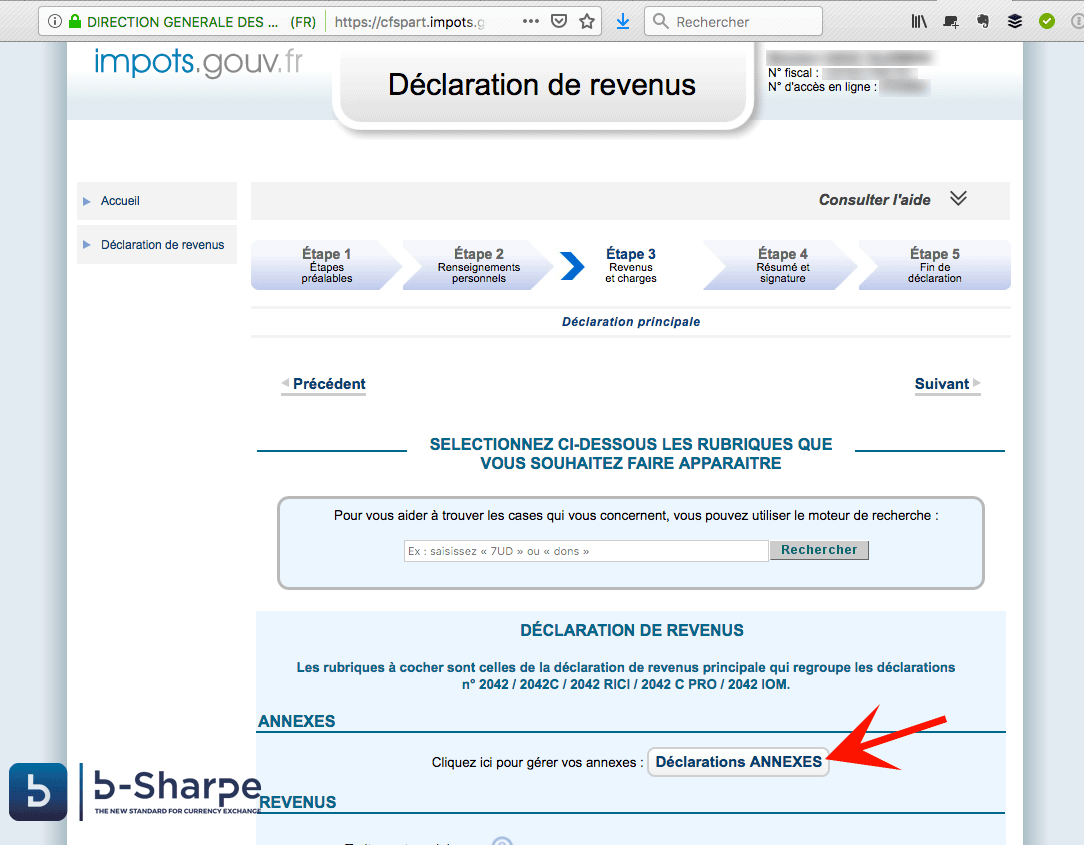
By clicking the “Supplementary returns” button, you will get access to a list of supplementary returns that you need to tick in order to see them.
In the example given below,
- The “2019 property income declaration” box (red arrow) brings up annex 2044, which lets you declare any rental income
- The “Declaration of 2019 income received abroad by a taxpayer resident in France” box (blue arrow) brings up annex 2047, allowing you to declare your Swiss income, along with the worksheet for calculating Swiss salary
- The “Declaration by a resident of an account held outside France” box (green arrow) brings up annex 3916, letting you enter your various foreign accounts.
For a “standard” return filed by a taxpayer working in Switzerland, annexes 2047 and 3916 must be selected. The others depend on your personal situation.
How do you calculate the Swiss-source income to include in your tax return?
The income to take into account for the 2020 return is the income earned in 2019, whether Swiss, French or from elsewhere.
Specifically for Swiss income, the following must be included:
- the salary from your professional activity in Switzerland
- variable pay and any bonuses
- ancillary salary benefits such as partial or full coverage of health insurance, or the private-use portion of a company car…
Taxable income is the sum of the net amounts received by the employee. This information appears on the salary certificate that your employer would normally have given you at the start of the year, a document that summarises all this information.
Unlike employees in France, for whom the French tax authorities pre-fill a tax form that only needs to be checked and validated, people who work in Switzerland and live in France will need to calculate their own Swiss income to declare, based on the information provided by their employer.
In this respect, the salary certificate issued by the employer is a central document, without which you will not be able to complete your tax return. If your employer(s) did not give it to you at the start of the year, ask for it.
Which tax form should you use to declare your Swiss income?
As your income comes from a Swiss source, the French tax office needs to carry out a few preparatory calculations before it can be included in your French tax return. To do this, you will need to complete annex 2047, using your Swiss salary certificate to help you.
#1: State that your income is Swiss-source
When you log in to the tax authority’s website, in supplementary return no. 2047, make sure you tick the 2 boxes as shown in the screenshot below: this will then give you access to the declaration screens specific to people living in France and working in Switzerland.
#2: Calculate your net taxable Swiss salary
The next screen is then the worksheet for calculating net taxable Swiss salary, which lets you “convert” your income from Swiss francs into euros and carry it over to your tax return.
To do this, select the member(s) of the tax household who work in Switzerland, as well as the number of cantons you worked in during the year. For example, if a temporary worker resident in France worked, during the year, in the canton of Geneva, the canton of Vaud and the canton of Neuchâtel for 3 different employers, they should select “3” in the “Number of cantons” box. On the other hand, if you worked for several employers in the same canton, you will need to add up the amounts yourself from the various salary certificates you were given.
#3: Declare your income for each canton
On the next page, it is important to correctly select the canton of employment as well as the employer (if you had more than one, list them in the text box provided for this purpose). Also indicate the number of months for which you received a salary, and enter in the boxes the information from your Swiss salary certificate(s).
#4: Fill in the boxes using your salary certificate
The next step is simple, as it just involves matching the numbers on your salary certificate with those shown in supplementary return no. 2047 and filling in the corresponding boxes. We have given an example below, and leave it to you to continue based on your income.
Please note that you will also need your proof of payment of your health insurance premiums (CMU for cross-border workers – CNTFS or LAMal) to complete this form, as shown in the screenshot below. Don’t forget it, as these amounts paid are deducted from your income; it would be a shame to miss out on that.
As shown in the screenshot below, LAMal contributions on the one hand, and CNTFS/URSSAF (CMU) contributions on the other, must not be entered in the same place.
#5: Calculating the carry-overs
Once you have entered the information from your salary certificate (or certificates, if you have more than one) for each canton, the tax office will carry out what’s known as a carry-over: the amount it calculates based on the information you have provided is then carried over to your other annexes, in specific boxes, depending on your situation.
It is therefore important to clearly indicate your situation to the tax authorities, as the carry-overs can differ from one situation to another (for example, the carry-overs for French residents working in the cantons of Vaud, Valais, Jura, Neuchâtel, Basel-Stadt, Basel-Landschaft, Bern and Solothurn will not be the same as for those working in the canton of Geneva).
Once the box is ticked, the next screen lets you see the amount in EUR that is used by the French tax authorities for your return. This amount is then, in principle, carried over to your annex 2047.
Please note: the service does state clearly that the carry-over will be made. However, this is sometimes not the case, or it is not done correctly. We therefore recommend checking carefully that the carry-overs have been made to the correct boxes.
Which EUR/CHF exchange rate should you use for your tax return?
The EUR/CHF exchange rate to use for the 2020 tax return is 1 CHF = 0.90 EUR. It is provided here for reference or verification purposes, as it is in any case calculated automatically by the tax office’s online service.
Which bank accounts do you need to declare?
French tax law requires taxpayers to declare any foreign bank accounts they hold. Accounts on which there was at least one debit or credit transaction during the tax year must be declared. This declaration is made on annex 3916. It simply involves declaring the account numbers and the banking institutions.
From one year to the next, for those who have already filed several returns, the carry-over system lets you automatically bring over the information entered the previous year (see screenshot below).
If you’re not sure exactly which account to declare, we invite you to read this post, which deals specifically with declaring foreign bank accounts.
Conclusion
We hope this guide has helped you with your tax return. If it has, don’t forget to share this article with your friends, and think of b-sharpe, Switzerland’s first online currency exchange service offering preferential rates for your currency transactions: registration is free!
Important: this article should in no way be considered tax advice.
Credit: all screenshots are taken from the impots.gouv.fr website.