The yen finds itself at the centre of a foreign exchange market that has become particularly asymmetrical.
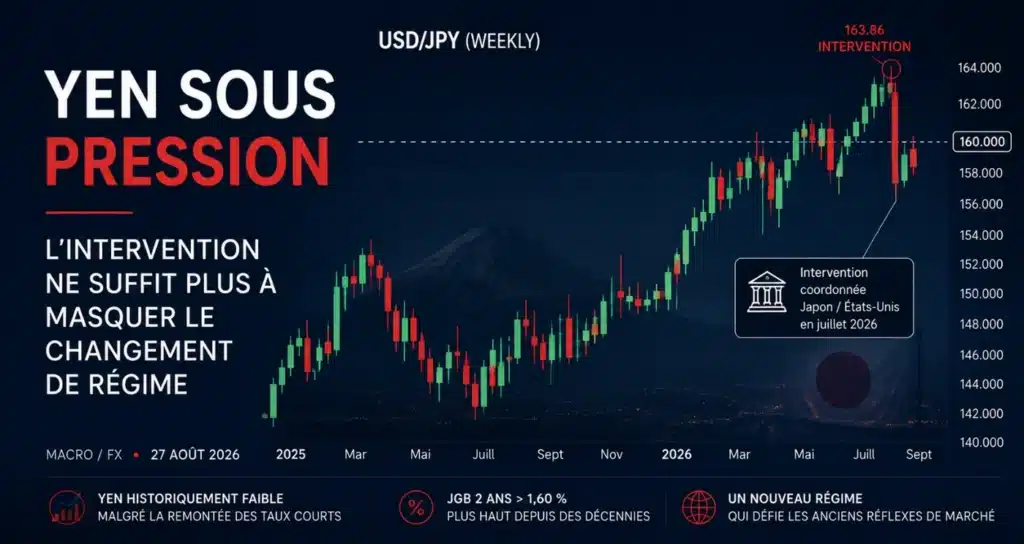
After reaching 163.86 against the dollar in July, the USD/JPY triggered a coordinated intervention by the Japanese and US authorities. At the same time, the yield on the 2-year JGB exceeded 1.60 per cent, a level not seen for several decades.
This situation is significant: a historically weak yen, coupled with a sharp rise in Japanese short-term interest rates, is becoming increasingly unsustainable.
But a new factor has changed the picture: on 19 August, the US Treasury announced that, from 9 September, it would at least double the scale of its buy-back operations designed to support liquidity in long-dated nominal Treasuries. The initial reaction was a fall in US yields and the value of the dollar.
For the FX market, the message is important: the interest rate differential could now narrow on both sides.
The risk of intervention changes the dynamics
For years, the yen’s weakness was mainly due to an interest rate differential that was extremely favourable to the dollar.
The mechanism was simple: borrow yen at a low cost, buy assets in dollars and profit from the carry trade.
However, above 160 on the USD/JPY, the market must now factor in a new variable: the risk of intervention.
The coordinated response by Tokyo and Washington showed that the authorities were prepared to take action in the event of what were deemed to be disorderly gatherings.
The problem for yen sellers is therefore twofold:
the cost of yen-denominated financing is rising;
The risk of official intervention is now a real possibility.
And if US long-term interest rates stabilise or fall, the yield spread may also begin to narrow.
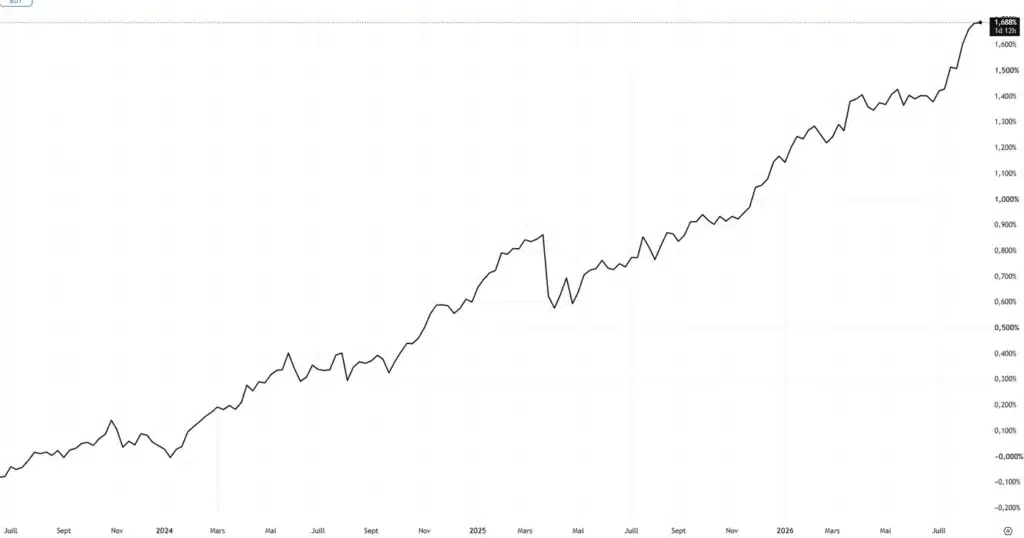
The real indicator: the 2-year JGB
The FX market traditionally focuses on the yield spread between the US and Japan. However, at this stage, the 2-year JGB deserves particular attention.
Its rise to 1.60 per cent reflects expectations of a significantly less accommodative Japanese monetary policy.
The market is now largely pricing in a continuation of monetary normalisation. Following the comments made by Deputy Governor Ryozo Himino on 27 August, the implied probability of a 25-basis-point rise in September – which would bring the key interest rate to 1.25 per cent – now stands at around 85 per cent.
In other words, the bond market is sending a signal that the foreign exchange market has not yet fully taken on board:
The cost of yen-denominated funding is no longer structurally bound to remain close to zero.
And that is precisely what threatens the carry trade.
The US Treasury is also becoming a factor in the FX market
The US Treasury’s decision adds a new dimension.
Washington is now showing that it is prepared to step up its support for liquidity in long-term maturities when tensions in the bond market become significant.
This is not conventional QE, and the bond-buying programme is not enough to reverse the fundamentals of US debt.
However, if US long-term interest rates stop rising whilst Japanese rates continue to rise, the yield spread could narrow more quickly than expected.
The carry trade is entering a danger zone
The carry trade works when three conditions are met:
a significant interest rate differential;
low FX volatility;
a yen that does not appreciate sharply.
These three conditions are gradually becoming less favourable.
The dangerous scenario is not necessarily a sharp rise in Japanese interest rates.
It is more a combination of a rise in Japanese short-term interest rates, a stabilisation of US interest rates and a rapid appreciation of the yen.
In this case, the foreign exchange loss can quickly wipe out the carry return.
And the phenomenon can become self-fulfilling:
Investors close out their positions → buy yen → the yen rises → other investors then close out their positions as well.
But the FX market has still not given in
This is probably the most important point.
Despite the intervention, the rise in Japanese interest rates and expectations of a BoJ rate rise in September – which are now very much priced in – the USD/JPY has still not shown any signs of a genuine structural reversal.
The cross rate is still hovering around 159, illustrating particularly clearly the divergence between the signals sent by the Japanese bond market and those sent by the foreign exchange market.
A shift in market trends may therefore be on the cards, but this has not yet been confirmed by the price.
It is this divergence between the bond market and the foreign exchange market that is worth keeping an eye on at present.
USD/JPY: the risk is no longer just of a rise
Around 160, the risk/reward ratio for a short position in the yen changes dramatically.
At 150, selling the yen might have seemed like a relatively straightforward macro trade.
At 160, the same trade also becomes a bet on the Japanese authorities’ ability to refrain from intervening.
This creates a particularly asymmetrical market structure:
USD/JPY rising → increased risk of intervention.
USD/JPY falling → increased risk of carry trade unwinding.
And the rise in US yields adds a third variable:
US interest rates rising sharply → increased risk of a response from the US authorities.
This is precisely the sort of situation that can lead to a sharp rise in volatility.
The four indicators to keep an eye on
For FX traders, four factors will be particularly important:
The 2-year JGB: a continued rise would reinforce expectations of normalisation by the BoJ.
The US/Japan 2-year spread: this will help gauge whether the US yield advantage is actually beginning to narrow.
The 10-year/30-year Treasury spread: the question will be whether US long-term rates can continue to rise despite the announced increase in Treasury buybacks.
USD/JPY around 160: repeated failure to break above 160 on a sustained basis, despite an environment that remains favourable to the dollar, would be a particularly interesting signal.
Conclusion
The yen is at a historic low at the very moment when Japan is once again offering a significant bond yield.
At the same time, the United States is signalling that it is prepared to step up liquidity support for long-term maturities in the Treasury market.
The change of regime has therefore not yet been confirmed.
But the risk asymmetry is very real.
The question is no longer simply:
How high could the USD/JPY rise?
It becomes:
How many short JPY positions can still remain open if the interest rate differential starts to reverse, given that the risk of intervention is now a real possibility?
USD/JPY
~159.3
2-year JGB
~1.60 per cent
US 10Y
~4.7 per cent
US 30Y
>5.2 per cent
The yen remains at historically low levels as Japanese interest rates rise sharply.