


BEN, SHARE, OUR: International payment options
When making an international payment, you can choose how the fees are allocated. In this article, we explain the difference between the three possible arrangements: whether the sender covers all the fees, the fees are shared, or they are charged to the recipient.
• International transfers outside the SEPA zone involve bank processing fees allocated according to three standardised schemes: SHA, BEN and OUR.
• The SHA (shared) scheme, the most common, splits fees between the sender (originating bank) and recipient (intermediary and receiving banks).
• These fees, typically ranging from a few to several dozen francs, are rarely predictable in advance and should be anticipated before any international transfer.

Which payments are affected?
This article covers the payment scheme that applies to all international financial transactions outside the SEPA area. Indeed, this involves a cost structure defined directly by the directives and specific characteristics of this type of transaction.
All transfers outside the SEPA framework are therefore covered by these various schemes, including express payments in euros, which by definition fall outside SEPA.
Why are there fees on international transfers?
A banking transaction is not simply about transferring funds from Bank A to Bank B — it is a secure and reliable exchange of information between two private entities, often operating in two different countries, which may require the involvement of several other entities before reaching its destination.
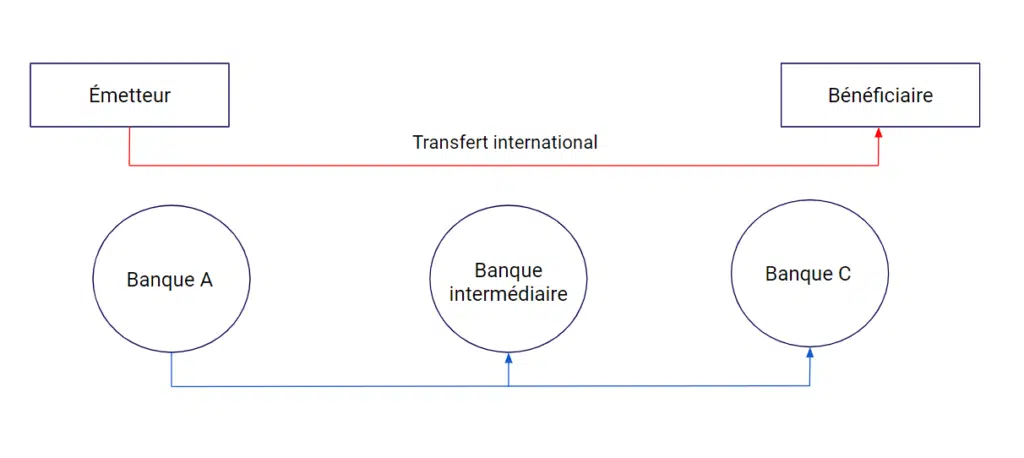
Setting up this type of payment involves fees charged by the financial institutions handling the transaction. These fees can be substantial and should be taken into account before making any payment.
These fees are generally made up of administration and processing charges and, unfortunately, can very rarely be predicted before a transaction takes place. To manage these fees, banks and financial institutions have introduced standardised payment and cost schemes. These schemes determine whether the sender or the beneficiary is responsible for the fees relating to the transfer.
These administration and processing fees typically range from a few francs to several dozen francs, for example for a transfer to the United States.
There are currently 3 main fee schemes: OUR, BEN and SHA. Each of these 3 schemes has its own specific features and advantages.
The 3 cost schemes:
To explain the terms of each of these three options, we will refer back to the diagram at the top of the page.
SHA: Share, or shared fees
This is the default scheme used when processing a financial transaction. It splits the fees between the sender and the beneficiary, as follows:
- Fees relating to the sender’s bank (Bank A) are borne by the sender.
- Fees relating to the intermediary bank and the beneficiary’s bank (Bank C) remain payable by the beneficiary.
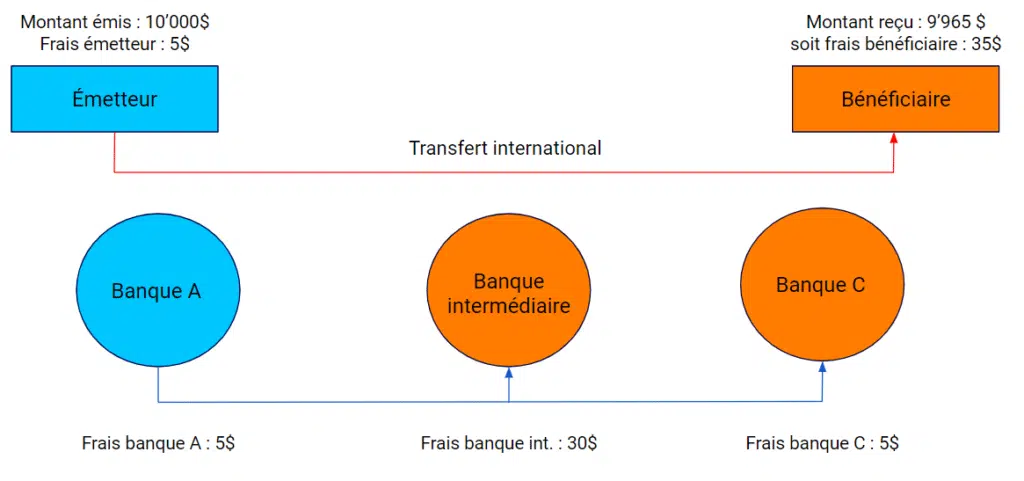
Please note that when paying under this scheme, your beneficiary is likely to receive a lower amount than the one you sent. It is therefore important to specify the scheme used when settling an invoice.
This is particularly important when paying an invoice to China or the United States, as intermediary banks will inevitably charge for their services.
OUR: Our, or fees borne by the sender
This scheme is far more specific and much less common, but it guarantees that the beneficiary receives the exact amount sent by the sender. Under this scheme, the sender bears all the fees relating to the transaction, so the beneficiary has nothing to pay and receives the full amount sent.
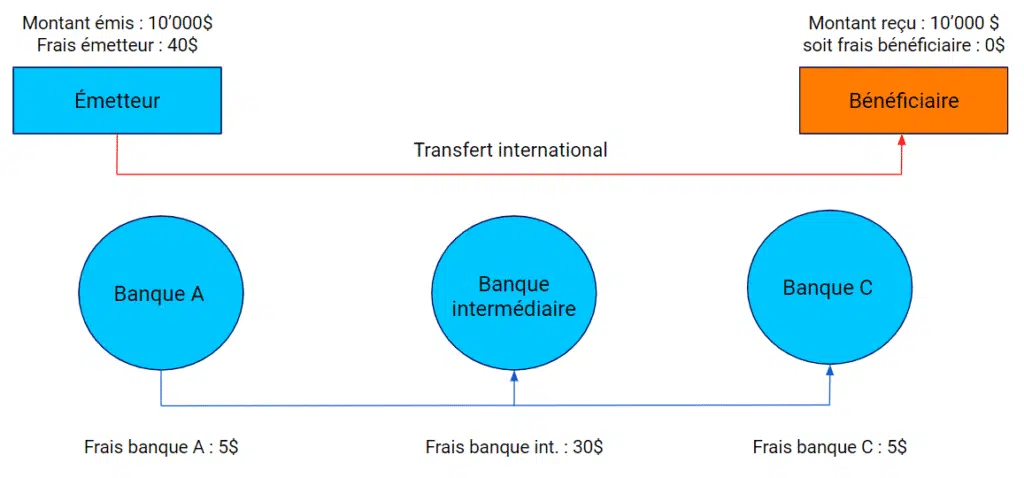
As fees are unpredictable, financial institutions tend to charge a flat rate to cover the full cost. This usually amounts to around thirty francs and is a very specific option, mainly used by businesses.
As this scheme is not used by default, feel free to ask your financial intermediary whether it is the one you need.
BEN: Beneficiary, or fees borne by the beneficiary
This scheme is almost never used. It is often costly for the beneficiary and therefore does not address the challenges of paying an invoice. However, it can be useful when it is impossible to determine the exact cost of a transaction, or under certain types of contracts.
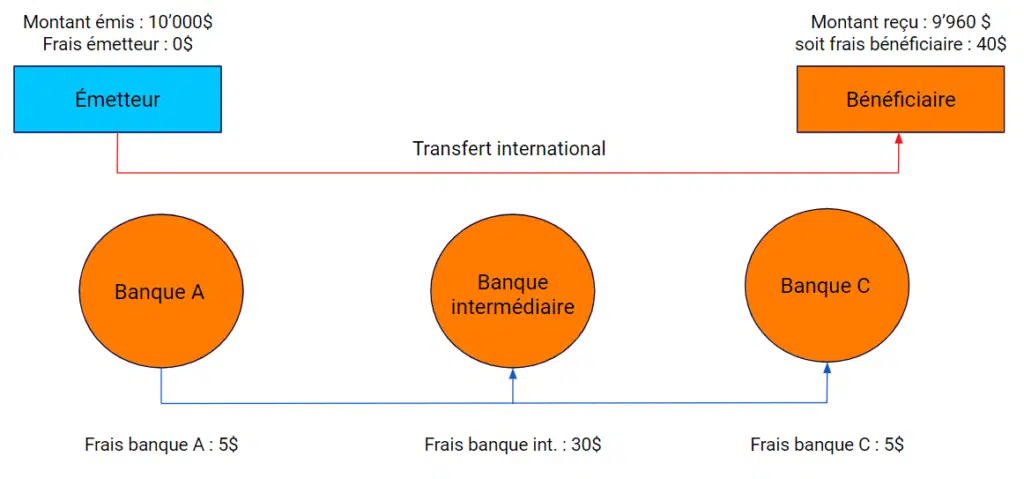
Under this scheme, all costs relating to the transaction are borne by the beneficiary. As a result, the sender knows exactly how much will be debited, whereas the beneficiary can be certain of receiving less than the amount sent. This is useful when there is no contractual constraint and you want to pay a precise amount, regardless of the amount the beneficiary ultimately receives.
So what about b-sharpe?
As part of our offering that lets you pay your international suppliers directly, b-sharpe is able to offer you all three of these cost schemes.
Like other financial institutions, we use the SHA scheme by default, free of charge.
At your request, when quoting the rate for settling your invoice, we can use the OUR scheme and therefore cover the full transfer fees. This scheme costs CHF 28.
The BEN scheme, although less commonly used, remains available and is entirely free of charge.
Conclusion
The cost scheme is therefore a key element in signing and managing a commercial contract involving international financial exchanges. Each of these three solutions is sound, with its own advantages and drawbacks. As part of our activity, we offer all three methods depending on your needs and the constraints governing your international contracts. Feel free to contact us for advice on the best solution for your transactions. Our teams will be glad to give you the guidance you need to carry out your transaction successfully.