Swiss VAT 2026: everything you need to know about rates, returns and exemptions
- What is new for Swiss VAT in 2026?
- VAT rates in Switzerland in 2026: standard, reduced and special rate
- VAT and e-commerce: the rules for distance sellers
- How do you get a VAT number in Switzerland and register?
- How do you file and pay VAT in Switzerland?
- Swiss VAT refunds: conditions and procedure
- Exemption from registration, exclusion, deregistration: when do you not charge VAT?
- Frequently asked questions about VAT in Switzerland
With three rates and a single threshold, Swiss VAT has a reputation for being simple. But between the CHF 100,000 threshold, the choice of accounting method and formalities now handled online, there are plenty of pitfalls. Which rates apply in 2026? Will VAT go up? When do you have to register and how do you get your VAT number? And if your cash is in euros, how do you pay VAT due in francs without losing out on the exchange? This guide sets out the facts, based on official sources from the FTA and the Confederation (2024 to 2026).
• In 2026, three VAT rates apply in Switzerland, unchanged since 2024: 8.1% (standard), 2.6% (reduced) and 3.8% (accommodation).
• On 29 November 2026, the people vote on an increase to 8.5% and 4% (reduced rate unchanged), which would apply from early 2028 at the earliest.
• VAT registration is mandatory from CHF 100,000 of worldwide turnover (CHF 250,000 for certain associations), with 30 days to register with the FTA.
• Returns are quarterly (effective method) or half-yearly (net tax rates), annual on request for SMEs, with payment within 60 days.
• Registration, returns and payments are handled online on the FTA portal. The tax liability is due in Swiss francs.

- What is new for Swiss VAT in 2026?
- VAT rates in Switzerland in 2026: standard, reduced and special rate
- VAT and e-commerce: the rules for distance sellers
- How do you get a VAT number in Switzerland and register?
- How do you file and pay VAT in Switzerland?
- Swiss VAT refunds: conditions and procedure
- Exemption from registration, exclusion, deregistration: when do you not charge VAT?
- Frequently asked questions about VAT in Switzerland
Swiss VAT (value added tax) is a federal consumption tax governed by the VAT Act (VATA). The end customer pays it, but it is the VAT-registered businesses that charge it, collect it and pass it on to the Confederation. In 2026, three rates apply: 8.1% (standard), 2.6% (reduced) and 3.8% (accommodation). A business must in principle register once its worldwide annual turnover reaches CHF 100,000. A foreign company only has to register if it supplies goods or services in Switzerland.
This guide is for self-employed people based in Switzerland, SME managers and French or Swiss businesses active on both sides of the border. It covers the rates, registration, VAT returns, refunds and the cases of exemption, under the rules in force in October 2026.
What is new for Swiss VAT in 2026?
The rates remain at 8.1%, 2.6% and 3.8%, as they have been since 2024. Two things are changing: a single online portal for your formalities and the vote of 29 November 2026 on an increase that would apply in 2028 at the earliest.
Rate changes on 1 January 2026
Nothing changed on 1 January 2026. The next step will be decided at the ballot box. In June 2026, Parliament decided to raise VAT to fund part of the 13th OASI pension (AHV/AVS). The people and the cantons will have the final say on 29 November 2026 (source: Federal Social Insurance Office, in German).
VAT in 2026 and the proposal put to the vote on 29 November 2026
| Category | In force in 2026 | If the increase is approved (early 2028 at the earliest) |
|---|---|---|
| Standard | 8.1% | 8.5% (+0.4 points) |
| Reduced | 2.6% | 2.6% (unchanged) |
| Accommodation | 3.8% | 4.0% (+0.2 points) |
Source: FSIO, vote page published on 5 October 2026. No increase will apply in 2026 or 2027.
⚠️ Watch out: for contracts, subscriptions or quotes running beyond 1 January 2028, include a clause that lets you pass any change in VAT on to your customer.
What is changing in your VAT formalities in 2026
Since 11 May 2026, registration and online returns go through the FTA portal and its VAT return service (source: Federal Tax Administration). You log in with AGOV, the Swiss authorities’ login, which replaces CH-Login by 31 October 2026. From 1 January 2027, formalities relating to net tax rates, flat tax rates, group taxation and deregistration must go through this portal.
VAT rates in Switzerland in 2026: standard, reduced and special rate
Switzerland applies three rates in 2026. The standard rate of 8.1% covers the vast majority of goods and services. The other two are exceptions. Do your invoice templates still show 7.7%, 2.5% or 3.7%? Those are the rates that applied until the end of 2023: update them.
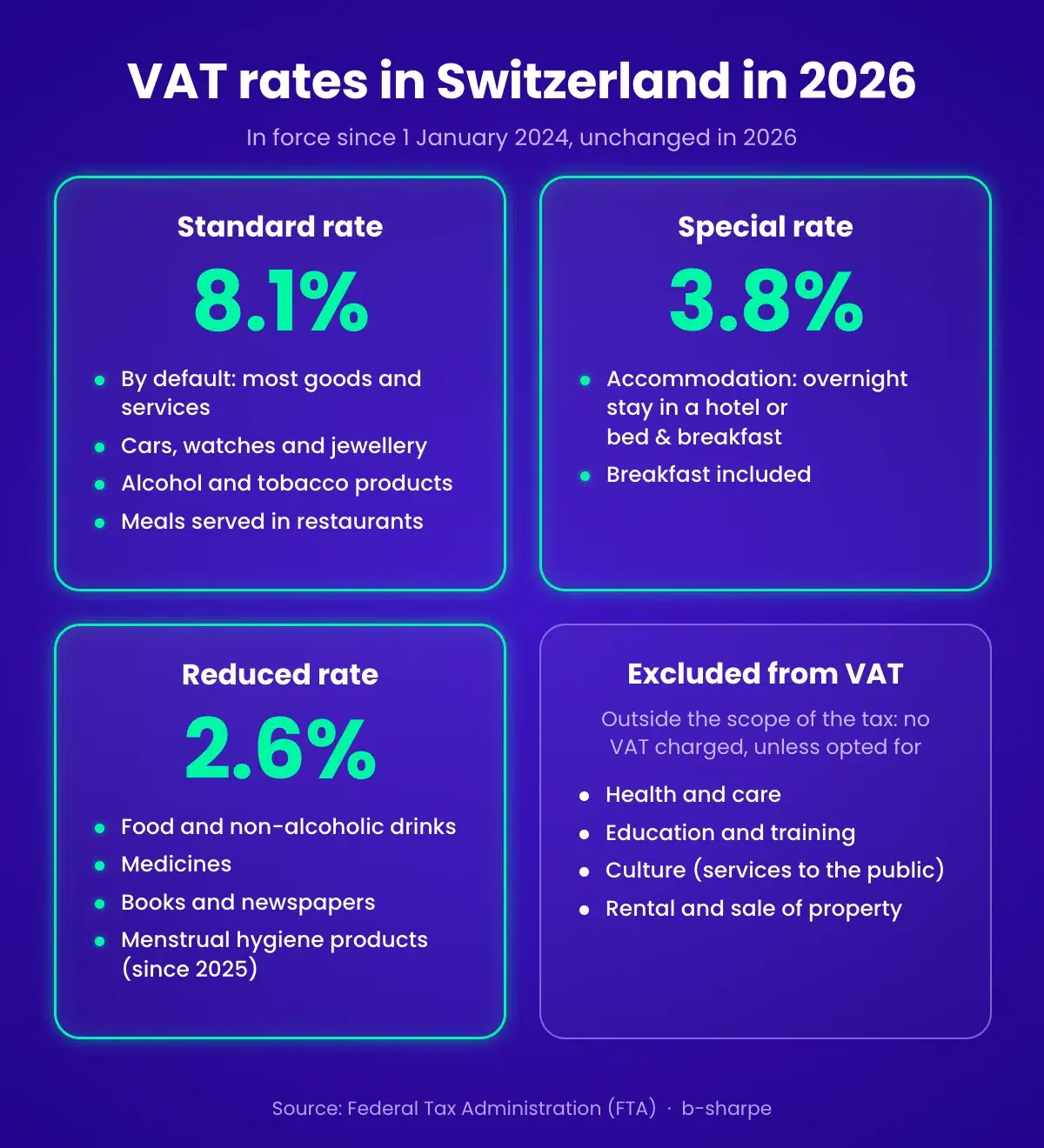
The 3 VAT rates in Switzerland in 2026
| Category | Rate | Scope | Examples |
|---|---|---|---|
| Standard | 8.1% | By default: supplies of goods and services taxable in Switzerland | Consulting, IT, building work, clothing, alcoholic drinks, meals served in restaurants |
| Reduced | 2.6% | Basic necessities | Food and non-alcoholic drinks (including takeaway), medicines, books and newspapers, menstrual hygiene products |
| Accommodation | 3.8% | Accommodation only | Overnight stay in a hotel or a bed & breakfast, breakfast included |
Source: FTA, rates in force since 1 January 2024.
How do you calculate VAT on your sales and services?
VAT is added to the price excluding VAT: you charge it to your customer, then pay it over to the federal tax authorities. Three formulas are all you need:
- VAT = price excl. VAT × rate
- price incl. VAT = price excl. VAT × (1 + rate)
- price excl. VAT = price incl. VAT ÷ (1 + rate)
Example: a consulting service invoiced at CHF 2,000 excluding VAT gives 2,000 × 8.1% = CHF 162 of VAT, so CHF 2,162 including VAT. Conversely, CHF 1,081 including VAT at the standard rate corresponds to CHF 1,000 excluding VAT, of which CHF 81 is VAT.
This Swiss VAT calculator works in both directions:
Swiss VAT calculator 2026
Indicative result, rounded to the nearest centime, at the rates in force in 2026.
Save on EUR/CHF exchange for your VAT payments
Your VAT liability is set in Swiss francs. If your cash is held in euros, every payment involves a conversion, with a cost that is rarely visible: the exchange margin. On a transfer, many banks apply a less favourable rate than the interbank rate (the rate at which banks trade currencies with each other, with no margin), with a difference of up to 2%. For an SME that pays its VAT every quarter, this cost comes back at every due date. That is why a currency exchange solution for Swiss SMEs makes more sense than the exchange your bank offers by default.
On a quarterly VAT bill of CHF 10,000 paid from a euro account, each percentage point of margin costs about CHF 100 per payment:
What the exchange margin costs on VAT of CHF 10,000 per quarter
| Margin applied | Cost per payment | Cost over a year (4 payments) |
|---|---|---|
| 2% | CHF 200 | CHF 800 |
| 1% | CHF 100 | CHF 400 |
| 0.5% | CHF 50 | CHF 200 |
Indicative calculation: cost of the exchange margin alone, excluding any fixed fees and exchange rate movements.
The smart habit for your VAT payments
The habit is simple: before each payment, compare the rate your bank offers with the market rate, which you can follow in real time on the EUR/CHF currency converter. The difference between the two is your bank’s exchange margin. Commissions or transfer fees may come on top.
In practice, here is how b-sharpe works: the conversion starts from the interbank rate, with fees from 0.12% that decrease with the amount. You see the exact amount in francs before you confirm. The funds usually arrive 1 to 2 working days after your transfer is received, which leaves time to pay the FTA without risking the deadline.
VAT and e-commerce: the rules for distance sellers
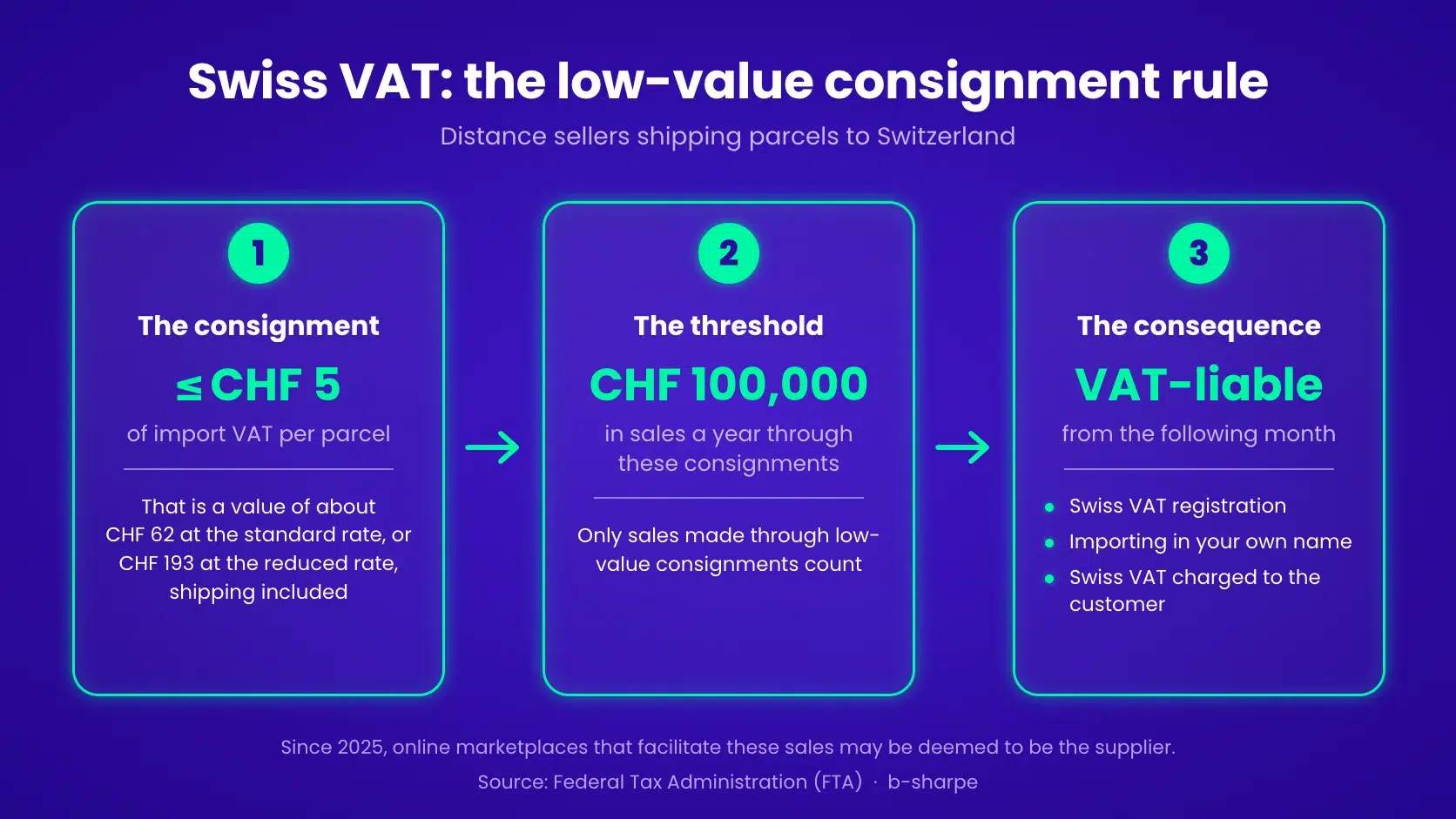
- The general threshold: an online seller is subject to the same rule as any business. It becomes liable for VAT once its relevant turnover reaches CHF 100,000, as explained in the section on registration.
- The low-value consignment rule: it applies to sellers who ship parcels from abroad. A low-value consignment is a parcel on which the import VAT does not exceed CHF 5, which means a value of about CHF 62 at the standard rate or CHF 193 at the reduced rate, shipping included. Once your sales made through such consignments reach CHF 100,000 a year, you become liable for VAT in Switzerland.
- What changes next: from the following month, all your deliveries to Switzerland are deemed to take place in Switzerland. You import in your own name and charge Swiss VAT to your customers (source: FTA). So that they do not pay it a second time on delivery, give the carrier your VAT number and an invoice that shows the Swiss VAT.
- The case of marketplaces: since 2025, an online platform that facilitates deliveries of goods is, under certain conditions, deemed to be the supplier. It is the platform that declares and pays the VAT on these sales. Transport and accommodation platforms are not affected.
How do you get a VAT number in Switzerland and register?
To get a VAT number, you register online on the FTA portal within 30 days of becoming liable for VAT. The number is your business identification number (UID) followed by the word “VAT”.
Mandatory registration threshold: CHF 100,000 in turnover
Do you live in France and work as a self-employed person in Switzerland? Unlike employed cross-border workers, you may be subject to Swiss VAT, depending on your activity, your income and the country where your services are supplied. The threshold is calculated on relevant turnover: your sales in Switzerland, your exports (even though they are invoiced without VAT) and the services you supply in another country. Only services excluded from the scope of the tax are deducted.
Example: a Geneva SME that invoices CHF 60,000 of consulting to Swiss clients and CHF 50,000 to French clients reaches the threshold.
A foreign company is only concerned if it supplies goods or services in Switzerland: a French company that sells only in France owes no Swiss VAT. It remains exempt from registration if all it supplies in Switzerland are zero-rated transactions or services subject to acquisition tax (source: FTA).
Registration thresholds and deadline in 2026
| Entity | Annual threshold | Deadline to register |
|---|---|---|
| Swiss business, or foreign business supplying goods or services in Switzerland | CHF 100,000 in relevant turnover | 30 days after becoming liable for VAT |
| Non-profit sports or cultural association run by volunteers, public-benefit institution | CHF 250,000 in relevant turnover | 30 days after becoming liable for VAT |
| Distance seller (imported low-value consignments) | CHF 100,000 achieved through low-value consignments | 30 days after becoming liable for VAT |
Sources: art. 10 and 66 VATA.
When your VAT liability begins depends on your situation:
- If you are starting an activity and expect to reach the threshold within the first 12 months, it begins as soon as the activity starts.
- If your activity already exists, it begins at the end of the financial year in which the threshold was reached (art. 9 VATO).
Missing the deadline is costly: backdated registration, VAT claimed on your past sales, default interest of 4% a year in 2026 and 2027, possibly a fine.
Registering on the FTA portal
- Check your UID: every business entered in the commercial register has one. Otherwise, one is assigned when you register.
- Create your AGOV access, then log in to the portal.
- Complete the VAT registration in the portal: business details, activity, start date, expected turnover, chosen accounting method.
- Receive your VAT number in the format CHE-123.456.789 VAT (source: ch.ch). As a general rule, it must appear on the invoices you issue (art. 26 VATA).
Voluntary registration: benefits for small businesses
Below the threshold, you can register for VAT voluntarily to recover the VAT paid on your business purchases (“input tax”). This option is worthwhile mainly if you have large start-up investments, mostly VAT-registered customers or an activity focused on other countries. The downside: for private customers, VAT makes your prices higher.
How do you file and pay VAT in Switzerland?
Once you are registered, you send a periodic VAT return to the Federal Tax Administration (FTA) on its online portal. The return and the payment are due within 60 days of the end of each period. The FTA collects VAT on transactions carried out in Switzerland. The Federal Office for Customs and Border Security (FOCBS) collects the VAT due on imports of goods.
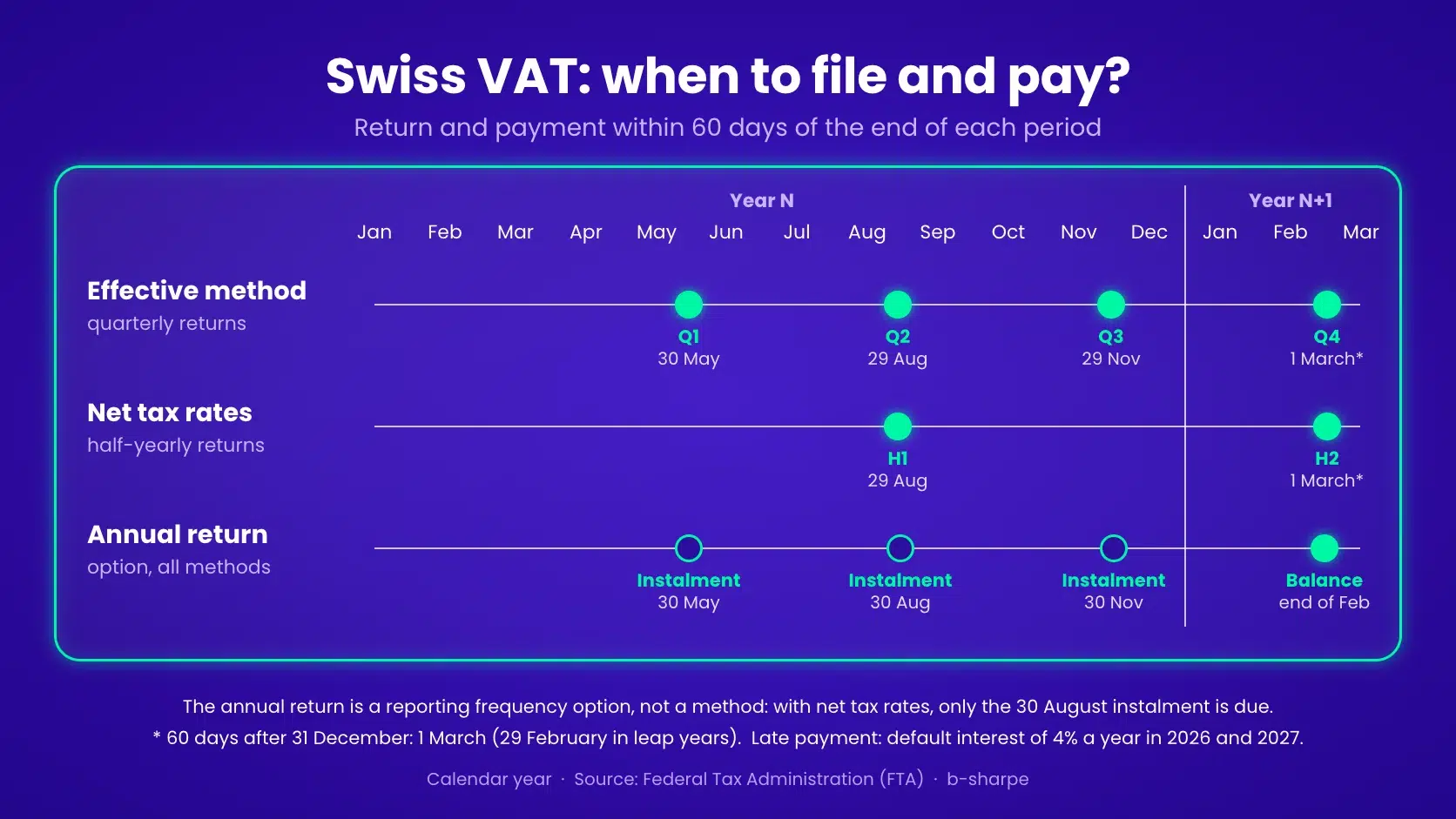
VAT returns for Swiss companies
Your return shows the VAT you invoiced minus the deductible input tax. Any balance in your favour is refunded to you.
Accounting methods: choose the option that suits your cash flow
With the effective method, input tax is deducted under the conditions of the VATA. Two variants set the moment when VAT becomes due:
- On the basis of agreed consideration (you invoice before being paid, VAT is due on the invoices issued): this is the usual variant.
- On the basis of received consideration, VAT is due on payments received, subject to approval. Returns are in principle quarterly. They can be monthly if you regularly have an input tax surplus.
Since 2025, SMEs whose turnover does not exceed CHF 5,005,000 can request annual returns with instalment payments, provided they have filed and paid their returns on time for the last three tax periods (or since they became liable for VAT, if that is more recent). The annual return is filed and paid before the end of February of the following year.
The simplified method: net tax rates (NTR)
- The conditions: the method is open to businesses whose taxable turnover does not exceed CHF 5.024 million a year including VAT and whose tax due does not exceed CHF 108,000 a year (source: FTA). Since 2025, it has been closed to companies headquartered abroad, to electronic platforms and to distance sellers liable for VAT on their low-value consignments.
- The principle: instead of calculating input tax invoice by invoice, you apply a flat rate set for your sector to your turnover including VAT. Example: an architect, whose rate is 6.2%, who receives CHF 400,000 over a half-year owes CHF 24,800 of VAT. Their invoices still show the statutory rate of 8.1%.
- Several activities: since 2025, each activity that accounts for more than 10% of your turnover is reported at its own net tax rate.
- The advantage: returns are in principle half-yearly or even annual on request, which noticeably lightens the administrative workload.
VAT for foreign companies operating in Switzerland
A business headquartered in another country that operates in Switzerland follows, in principle, the same rules as local companies, subject to the exceptions provided by law.
If they have neither a registered office nor a permanent establishment in Switzerland, these businesses must appoint a tax representative domiciled in Switzerland. Since 2025, the tax authorities can waive this requirement if their procedural obligations are guaranteed in another way (art. 67 para. 1bis VATA). A permanent establishment in Switzerland, such as a branch in Switzerland, is an independent taxable person subject to the same rules as a local company. Several permanent establishments form a single taxable person.
Before each VAT return: 5 checks
Rates
Your invoices show 8.1%, 2.6% or 3.8%, broken down by category.
VAT number
Your number CHE-123.456.789 VAT appears on every invoice you issue.
Due date
Return and payment within 60 days of the end of the period.
Input tax
You keep supporting evidence for each deduction (effective method).
Exchange
If you pay from euros, you have compared your bank’s rate with the interbank rate.
Optimise your VAT cash flow
If you run a French-Swiss SME or a foreign company, or if you are self-employed and paid in euros, the exchange margin comes back with every VAT payment. On VAT of CHF 8,000 per quarter, each percentage point of margin costs about CHF 80 per payment, or CHF 320 over the year.
With b-sharpe, your euros are converted on the basis of the interbank rate, with no hidden margin. On VAT of CHF 8,000 paid from a euro account:
- With your bank: the exchange margin is usually 2%, or about CHF 160 per payment. This cost is rarely shown clearly.
- With b-sharpe: exchange fees start at 0.12%. They decrease with the amount, so the cost runs to tens of francs, shown before each confirmation.
The exact amount is shown in the converter before you confirm. Businesses also have a dedicated contact for their currency transactions.
Swiss VAT refunds: conditions and procedure
- You are registered for VAT in Switzerland: the refund simply goes through your VAT return. If the deductible input tax exceeds the VAT due for the period, the tax authorities pay you the difference.
- Your business is foreign and not registered for VAT (a French company, for example): it can recover the Swiss VAT paid on its business expenses in Switzerland, such as a trade fair, a business trip or services bought locally, through a specific refund procedure. All the following conditions must be met:
- Its country grants reciprocity to Swiss businesses, which is the case for France.
- It supplies no goods or services in Switzerland, apart from rare exceptions provided for in the ordinance.
- The amount to be refunded is at least CHF 500 per calendar year.
- It appoints a representative domiciled in Switzerland.
- The claim is filed between 1 January and 30 June of the following year, a deadline that cannot be extended.
The file includes FTA forms 1222 and 1223, a certificate from the tax authority of the business’s country and the corresponding invoices, duly issued (source: FTA, VAT Info 18). The refund is paid in Swiss francs: if it needs to reach a euro account, you will still have to convert it.
Exemption from registration, exclusion, deregistration: when do you not charge VAT?
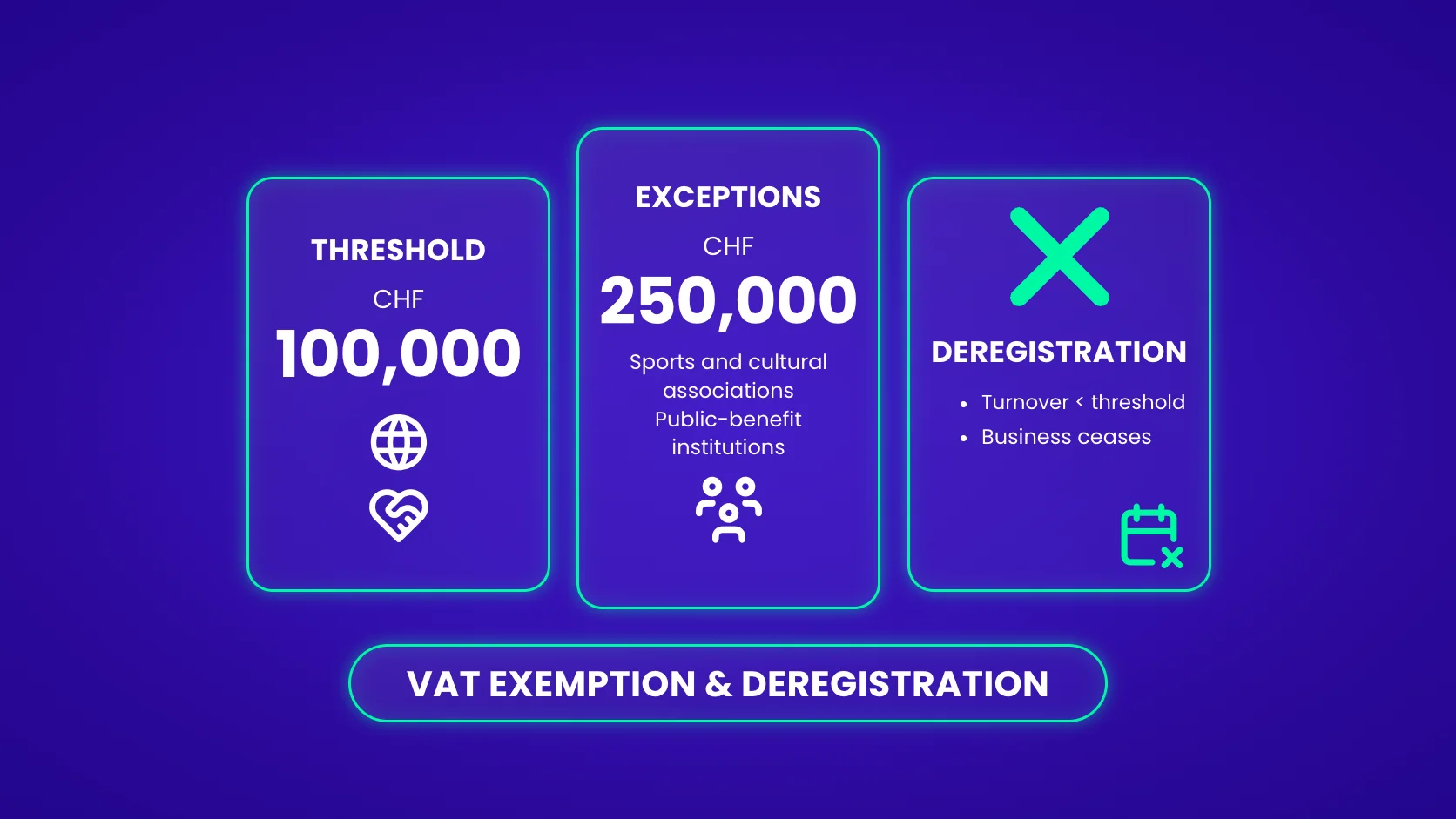
You do not have to register for VAT if your relevant turnover stays below CHF 100,000 (CHF 250,000 for certain associations) or if your activities are excluded from the scope of the tax. If you are already registered, you ask the federal tax authorities to remove you from the register, which is called deregistration. Three similar notions are often confused:
Exemption from registration, exclusion, zero rating: what sets them apart
| Notion | What it means | Input tax deduction |
|---|---|---|
| Exemption from tax liability | You do not have to register, for example because your turnover stays below the legal threshold. | No (except with voluntary registration) |
| Exclusion from the scope of the tax | Certain services (health, education, renting out property…) are not subject to VAT. | In principle no, on purchases linked to these services |
| Zero rating (exemption with deduction) | Certain transactions are invoiced without Swiss VAT: exports of goods shipped directly abroad, transport of goods linked to exports or imports, international passenger flights. | Yes |
Sources: FTA, art. 23 VATA for exemptions.
Businesses and associations exempt from registration (turnover threshold)
Every business, local or foreign, is exempt from tax liability if its relevant turnover, generated in Switzerland and in other countries, exports included, is below CHF 100,000 (art. 10 para. 2 let. a VATA).
The threshold rises to CHF 250,000 for non-profit sports and cultural associations run by volunteers and for public-benefit institutions (art. 10 para. 2 let. c VATA).
Business purpose (services excluded from the scope of the tax)
Regardless of your turnover, certain activities are excluded from the scope of VAT: they do not count towards the threshold and do not create a VAT obligation.
Main services excluded from the scope of VAT
| Area | Examples of excluded activities |
|---|---|
| Health and social care | Medical treatment and care, care coordination (since 2025), home help and care, social assistance |
| Education | Teaching, courses, training and examinations |
| Banking and insurance | Granting of credit and interest, most money and capital market transactions, insurance contracts |
| Property | Sale and rental of property, with the possibility of opting to tax under certain conditions. Exceptions include hotel accommodation and parking spaces, unless they are rented as an ancillary part of a property rental excluded from VAT |
| Culture and sport | Cultural services supplied directly to the public, active participation in cultural events (since 2025), admission and participation fees for sports events |
| Travel | Trips resold by Swiss or foreign travel agencies (since 2025) |
Non-exhaustive list. Reference: art. 21 VATA. Some exclusions allow an option to tax.
⚠️ Watch out: if your main activity is excluded (education, for example) but you also have a small taxable activity (selling books), only the turnover from the activity that is not excluded counts towards the CHF 100,000 threshold.
Other grounds for deregistration
Deregistration is not automatic: you have to request it from the tax authorities. From 1 January 2027, it will have to be done online.
The 3 cases of deregistration from the VAT register
| Situation | When VAT liability ends | Procedure |
|---|---|---|
| Drop in turnover | Relevant turnover below the threshold and probably also the following year | Request within 60 days of the end of the tax period concerned |
| Permanent cessation of activity | Retirement, return to salaried employment, completion of a liquidation | Written notification within 30 days (art. 66 VATA) |
| End of activity of a foreign company | End of the calendar year of the last transaction carried out in Switzerland | Request within 30 days |
Source: FTA.
💡 Good to know:
Once you are no longer liable for VAT, you lose the input tax deduction. If you have a lot of expenses, staying registered voluntarily may be more advantageous: weigh these deductions against the administrative workload.
Key points to remember:
In 2026, Swiss VAT remains at 8.1% (standard rate), 2.6% (reduced rate) and 3.8% (accommodation). Registration is mandatory from CHF 100,000 of relevant turnover, within 30 days. Each return must be paid within 60 days of the end of the period.
Two dates to keep an eye on: the vote of 29 November 2026 on an increase that would apply in 2028 at the earliest and the mandatory switch to the FTA portal for deregistration and flat-rate methods from 1 January 2027.
Every situation is different: mixed activities, foreign company, change of accounting method… If in doubt, contact a fiduciary (accounting firm) or the FTA.
Ready to take the next step? If you pay your VAT from euros, b-sharpe converts your funds on the basis of the interbank rate, at a much lower cost than the banks’ exchange margin, which can reach 2%. Fees are shown before you confirm: you know exactly how many francs you will receive before each transaction.
Frequently asked questions about VAT in Switzerland
Will Swiss VAT go up?
Not in 2026: the rates remain at 8.1%, 2.6% and 3.8%. On 29 November 2026, the people and the cantons vote on an increase to fund the 13th OASI pension. The standard rate would rise to 8.5% and the accommodation rate to 4%, while the reduced rate would stay at 2.6%. If approved, these rates would apply from early 2028 at the earliest.
Is Switzerland part of the European Union for VAT purposes?
No. Switzerland is a member neither of the EU nor of its VAT system: trade with France therefore does not fall under the intra-community regime. Goods sold from France to Switzerland are exported free of French VAT, then subject to Swiss import VAT, collected by the FOCBS.
Which accounting method should you choose: effective or net tax rate?
It depends on your purchases. The effective method lets you deduct the input tax actually invoiced: it is more advantageous if you invest or buy a lot. The net tax rate method applies a flat rate specific to your sector and simplifies administration. It is reserved for Swiss businesses whose turnover does not exceed CHF 5.024 million and whose tax due does not exceed CHF 108,000 a year.
Can I recover the VAT on my business purchases?
Yes, if you are registered for VAT and use the effective method: the VAT paid on your business purchases, called input tax, is deducted from the VAT due, subject to legal restrictions. With the net tax rate method, it is already taken into account in the flat rate. A foreign business that is not registered can use the refund procedure instead.
What happens if VAT returns are filed late?
The return and the payment are due within 60 days of the end of each period. For late payment, default interest of 4% a year applies in 2026 and 2027. Without a return, the FTA can set your liability by estimate. A fine may also be added.
How do I pay my Swiss VAT in euros from France?
VAT is paid in Swiss francs: you therefore need to convert your euros before paying the FTA. With a standard bank transfer, the conversion is made at your bank’s rate, whose margin can reach 2%. A specialist such as b-sharpe converts on the basis of the interbank rate, with fees from 0.12%, shown before you confirm.