


What is a safe-haven asset?
An asset is considered a safe haven when its value remains stable or tends to rise during major political, systemic or financial crises, such as the subprime crisis of 2008 or the health crisis the world is currently facing. Investors turn to this type of financial instrument in order to safeguard their assets as much as possible during periods that are not conducive to so-called risky investments.
• Gold remains the best-known safe haven, hitting a historic high of over $2,000 an ounce in 2020, thanks to its limited supply and stability against interest rate moves.
• The Swiss franc owes its safe-haven status to its solid banking sector, low debt levels and independence from the EU.
• Solid government bonds, the Japanese yen and the US dollar round out the traditional safe-haven assets, each with its own particularities.

The best known: gold
When you hear people talk about a safe-haven asset, even if you’re not part of the finance world, the one most often mentioned is gold. Whenever instability strikes anywhere in the world, gold is a highly sought-after asset because it acts as a secure investment, unlike a financial investment such as shares. It is also unaffected by low or high interest rates. Gold is also very easy to sell, whether in the industrial sector or in jewellery, and its supply is limited. The precious yellow metal reached an all-time high in 2020, with the price trading above $2,000 an ounce.
The strength of the Swiss franc
The Swiss currency has always been a safe-haven asset, especially in times of market instability. The main strengths of this currency come from the solidity of the banking sector and its thriving economy. Added to this is a very low level of debt compared with other OECD members and unemployment that remains very low. Furthermore, its independence from the surrounding European Union adds a further safe-haven quality for capital, particularly when the EU is hit hard by economic, political and health-related issues.
Government bonds
A government bond is simply an acknowledgement of debt issued by a government that provides for interest payments. Government bonds from developed countries (particularly G10 members) are also highly sought after during any instability, since the risk of a government default nonetheless remains minimal.
Is the yen safer than the US dollar?
The Japanese currency has for a very long time been a safe-haven asset that is almost more important than the greenback, given that the yen tends to appreciate more than the greenback during periods of destabilisation. This reputation stems from Japan’s high trade surplus relative to its debt throughout the 20th century. Nevertheless, Japan’s public debt is the highest in the world and represents more than 200% of Japanese GDP. Despite this, the yen remains a safe-haven asset, because Japan remains a powerful economy and more than 90% of the public debt is held by Japanese companies and households, which allows for a degree of stability.
The greenback, the most liquid currency
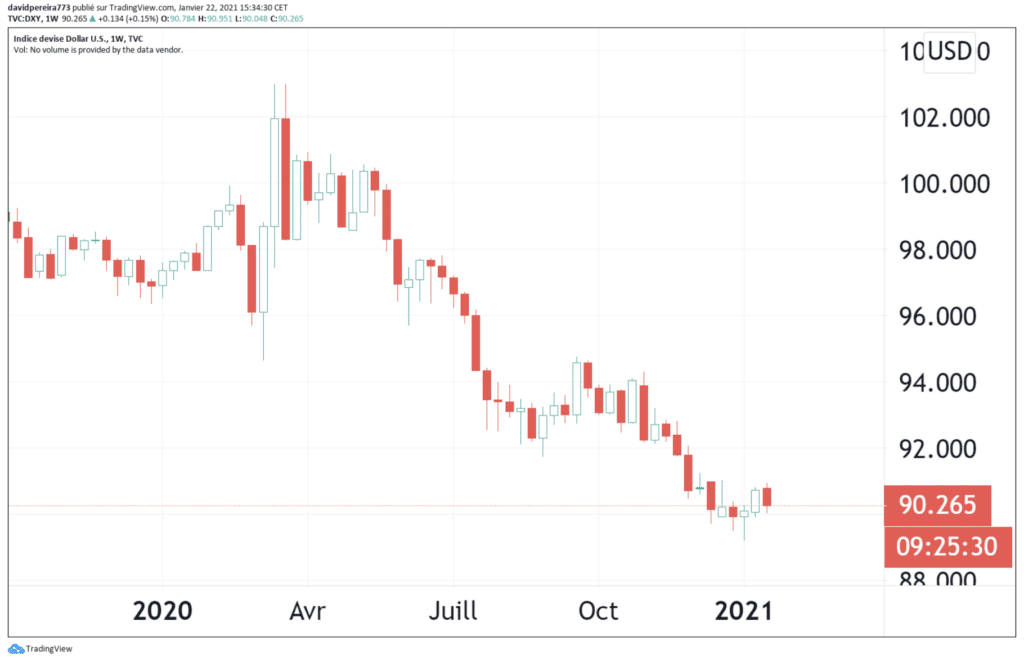
This confidence emerged following the Bretton Woods agreements, which established a fixed exchange rate and, in effect, propelled the greenback into becoming the world’s largest currency reserve. Then came the emerging-market crisis of the 2000s, which caused the dollar to appreciate even further. In addition, the dollar is the most liquid currency in the foreign exchange market and simply symbolises today’s largest economy in the world. However, the greenback would no longer be considered a safe-haven asset, and 2020 was probably proof of this. The DXY index, which is the benchmark index for the greenback against six major currencies including the euro, which carries a total weighting of 57%, was shaken during this period. After rising to 103 in March 2020, the strength of the greenback kept falling throughout this pandemic period, even reaching as low as 89.20 in early January 2021.
Chart of the DXY index on 22 January 2021
Cryptocurrencies
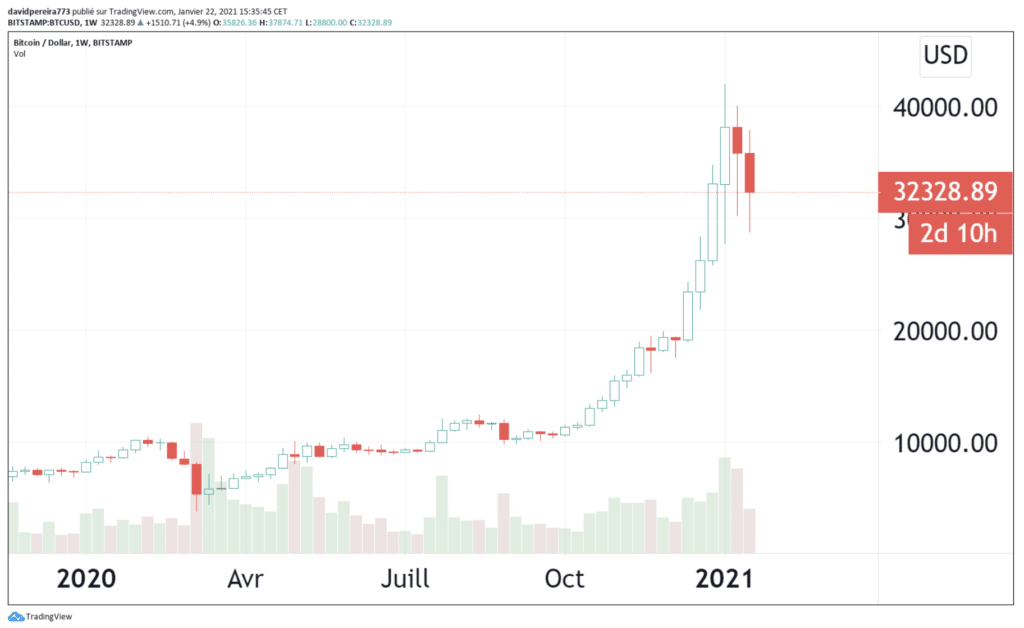
Let’s take a look at cryptocurrency, and Bitcoin in particular, which was mentioned during this crisis as a kind of safe-haven asset. Just like gold, Bitcoin is completely independent of politics and stock markets. However, its extreme volatility (up to +40% in a single day) has so far invalidated the idea that it could be a secure asset. As you can see below, Bitcoin has continued to appreciate since the start of the year, particularly during the first and second waves of COVID. It should not be overlooked that the greenback has depreciated, which makes dollar-denominated financial instruments more accessible (cheaper).
Bitcoin chart on 22 January 2021
One last interesting fact from this health crisis: technology stocks (GAFAM, Netflix and Tesla) recorded a considerable boom and were regarded as safe-haven assets during the first wave of the coronavirus. Their market capitalisation climbed exponentially, reaching 50% of the total value of the Nasdaq index by April 2020.
To sum up, 2020, being a particularly surprising year, probably put an end to the appeal of the greenback whenever the market is in risk-off mode. Conversely, newer assets such as technology stocks and Bitcoin came out on top. The question remains, however, whether this type of financial instrument could become the new safe-haven assets, or whether 2020 should simply be considered a one-off.