
Receiving your salary, paying bills or rent… Opening a Swiss bank account will certainly make all your financial arrangements (salaries, bills, rent) much easier once you’re there! Plan ahead by finding out about the banks and the various options available to you. In this article, b-sharpe, your currency exchange partner, explains everything you need to know about opening a bank account and Swiss banks.
Opening a bank account in Switzerland: a quick and easy process
Opening a bank account in Switzerland is easier than you might think. For French expats or cross-border workers, the process is usually quick. What are the requirements for opening an account in Switzerland? What supporting documents are required? Find out below.
Good to know: some Swiss banks, such as UBS and Credit Suisse, have branches in France where you can open a bank account.
How to open a bank account in Switzerland
When you open your new bank account in Switzerland, you will, of course, need to provide certain documents to your new bank. Whilst the required documents may vary from bank to bank, you will always be asked to provide:
- Proof of identity, such as a passport or national identity card;
- Proof of address (an electricity, internet or water bill, etc.)
- Bank statements;
- Proof of employment in Switzerland;
- Proof of income.
Is it possible for a French citizen to open a bank account in Switzerland?
Can I open a bank account in Switzerland if I am a French national? Absolutely. It is legal for French nationals to open a bank account in Switzerland. However, you are required to declare any bank accounts held abroad to the French tax authorities and to include them in your annual tax return.
Can you open a bank account in Switzerland if you are a non-resident?
Do you live in France or elsewhere abroad, outside Switzerland, and wish to open a bank account in Switzerland? It is possible! However, some banks may ask you to make a substantial deposit, or require you to provide proof of income to demonstrate your creditworthiness. Furthermore, the tax authorities in your country of residence must be notified of the opening of a foreign bank account. Your Swiss bank will therefore have to send a list of all transactions carried out to the tax authorities in your country every year.
Is it possible to open an account online?
Good to know: you can open a bank account in Switzerland online or remotely. However, you will need to submit all the necessary documents online or by post, depending on the option you choose.
Everything you need to know about banks in Switzerland
As you’re no doubt aware, Switzerland is the banking capital of the world! There’s therefore a wide range of banking options available… From traditional players such as PostFinance, Credit Suisse and UBS to neobanks like Swissquote and Yuh… How do you make sense of it all? Here are the key factors to consider when choosing your banking partner, before opening an account in Switzerland.
The advantages of Swiss banks
Why open a bank account in Switzerland? The Swiss banking system is renowned worldwide… Swiss banks offer a number of advantages:
- Greater security for funds: the Swiss financial landscape is one of the most heavily regulated in the world. Financial regulators impose strict rules on banks, particularly regarding the protection of funds and banking secrecy. Indeed, national law stipulates that banks may under no circumstances disclose their clients’ financial information.
- A world-renowned financial system: the Swiss financial centre offers banking services of the highest standard. This applies not only to traditional banks but also to private banks specialising in wealth management.
- Economic stability at national level: as you know, Switzerland is an economically stable country. Wages and the standard of living are very favourable. The Swiss minimum wage is among the highest in the world. The pension system (Swiss LPP) is also robust. Banks therefore benefit from a favourable political and economic climate.
Opening a bank account in Switzerland: how to choose the right bank?
Which is the best bank to open an account with in Switzerland? It’s hard to say, given the sheer number of banks in the country! They offer a range of services and tailor their offerings to their customers’ needs. Switzerland is a federal and multilingual state. As such, there are several types of banking institutions:
- Universal banks, which operate nationwide;
- Local banks operating at cantonal level;
- Co-operative banks;
- Private banks, which specialise in wealth management;
- Online banks (neobanks).
Are you looking to open a current account (also known as a salary account) in Switzerland? If so, universal or cantonal banks will undoubtedly be the most suitable option. Finally, there is another option available to you: online banks. Flexible and paperless, they often charge lower bank fees.
Are you a cross-border worker living in France? You should know that some Swiss banks offer so-called “cross-border” accounts, specifically designed for this particular status! These accounts offer few options, as they are designed solely to receive your salary and transfer it to a French account in euros. This is an advantageous and less expensive solution for having your salary paid in Swiss francs (CHF). However, you should check with your employer before opening a cross-border account with a French bank: some Swiss employers require a Swiss IBAN for salary payments.
The issue of bank charges
What are the costs associated with debit and credit cards? Bank charges in Switzerland are relatively high. This is an important point to bear in mind before opening a bank account in Switzerland. Be sure to compare the offers from different banks.
The amount of the monthly account maintenance fee varies from bank to bank. On average, it amounts to 20 Swiss francs for a current account that includes a debit card. The more features and services your bank account includes, the higher the fees will be. Withdrawals from ATMs (also known as Bancomats in Switzerland) belonging to your chosen bank are generally free of charge. Some banks charge a fee if you withdraw from a Bancomat belonging to another bank. International transfers or withdrawals abroad may also be subject to charges. The same applies to overdraft charges.
Finally, if you travel regularly within the eurozone or are a cross-border worker, consider choosing a bank that allows you to withdraw cash in both euros and Swiss francs. However, you can still exchange currencies online easily and at preferential rates using a euro-to-Swiss franc converter such as b-sharpe.
FAQ
Are you a cross-border worker or an expat looking to open a bank account in Switzerland? b-sharpe has all the answers to your questions about opening a bank account in Switzerland.
What are the requirements for opening a bank account in Switzerland?
Opening a bank account in Switzerland is a very straightforward process. This applies even to non-residents. What are the requirements? You must be of legal age, provide a work permit (or G permit), proof of identity and proof of address, as well as a statement explaining the source of your funds. Please note that US citizens may only open a Swiss bank account under certain conditions.
Can I open a business bank account in Switzerland as a French national?
Technically, yes. But that means your business must be registered in Switzerland. Switzerland offers many advantages for entrepreneurs, including a simplified administrative framework and faster processing times compared to France. However, certain eligibility criteria must be met to set up a business as a foreign national. Therefore, it is essential to hold a residence permit (type B or G) or to partner with a Swiss resident in order to legally establish a company in the country.
Setting up a business, and therefore opening a business bank account in Switzerland, can be more complicated for non-Swiss residents due to strict compliance requirements. Swiss banks scrutinise the source of funds and the business sector very closely. It is advisable to seek professional assistance to streamline this process and ensure compliance with Swiss banking regulations.
Can a French citizen open a bank account in Switzerland?
Yes, a French national can certainly open a bank account in Switzerland. However, the situation may vary depending on their residency status (residence permit, cross-border worker status, non-resident). Please contact a Swiss bank for further information.
Can you open a bank account in Switzerland for free?
Yes and no. Traditional Swiss banks charge account maintenance fees, so it is not possible to open an account with them for free. However, some online banks (or neobanks) based in Switzerland offer free account openings. You will then have a Swiss IBAN in CH. Some fees or services will subsequently incur a charge. Their services are provided entirely online. Please note: make sure you check carefully beforehand, as these banks are not always compatible with receiving your Swiss salary. Some employers require accounts with traditional banks. However, neobanks are still useful for holding a secondary account.
How can I convert my Swiss francs into euros without a Swiss bank account?
If you live or work between France and Switzerland, you will no doubt need to regularly convert currency between euros and Swiss francs, and vice versa. To exchange your currency, there are several options available to you, such as traditional banks or bureaux de change, financial institutions specialising in foreign currency conversion. It is also possible to exchange your euros or Swiss francs, as well as many other currencies, directly online. b-sharpe offers an online currency converter, updated in real time, for all your transactions. Take advantage of competitive rates to carry out your online currency exchanges in over 20 currencies: Swiss francs to euros, Swiss francs to pounds sterling, or even dollars to euros…
b-sharpe allows you to benefit from a very competitive exchange rate compared to traditional providers. The rate offered for EUR-CHF or CHF-EUR conversions is therefore significantly lower than that of a traditional bank. Every transaction is carried out with complete transparency. The fees applied to each transaction are clearly stated before each conversion. b-sharpe guarantees its users transparency and security.
To live in Switzerland, opening a local bank account is essential. But to help you settle in Switzerland and manage your finances, you will also need a currency converter. b-sharpe supports you in all your transactions, enabling you to exchange currencies online easily, reliably and transparently.
Hidden bank charges charged to private individuals – what you need to know!Tax regulations, types of banking transactions, the commercial policies of certain banks… Few people realise it, but there are many factors that can cause the bank charges levied on individuals to vary (and therefore increase).
It is therefore best to keep yourself informed about the main bank charges (which can sometimes be hard to spot), as you might unfortunately only realise what they are once they have been debited. As the saying goes: ‘forewarned is forearmed’!
Rather than compiling a tedious and incomplete list of Swiss bank charges, this article aims to help you gain a clearer understanding of certain practices that are far from being as transparent or advantageous as banks would have you believe.
Few individuals actually compare the costs associated with banking services
According to a study on currency exchange in Switzerland carried out in 2016 – which remains largely relevant today – of the 72% of individuals who transfer half or more of their salary to France, nearly 59% regard the cost of currency exchange as a key factor when choosing their bank.
However, very few retail customers actually compare exchange rates, spreads and direct or indirect bank charges… According to the same study, 35% of retail customers surveyed have never compared the charges for different services, and only 11% do so before each transfer.
Yet the potential savings are huge: with average fees of between 3% and 3.8% when using a bank, a private individual earning a salary of CHF 5,000 would save between €900 and €1,200 in exchange fees per year by using an online currency exchange service such as b-sharpe, rather than their traditional bank.
Costs associated with having a bank account abroad
In recent years, a great many individuals have noticed a significant rise in their bank charges; a rise that affects virtually all areas of expenditure.
For regulatory and supervisory reasons, the automation of the exchange of tax-related information between Switzerland and France has caused a sharp rise in the administrative costs associated with account management.
Charges such as ‘fees for non-Swiss bank accounts’, ‘non-eurozone bank charges’ and ‘tax statement fees’ have thus been levied on a massive scale. Whilst there is no question that these charges are justified, they are, above all, highly volatile and vary from one institution to another.
Do you need to manage a multi-currency personal budget? Discover our 6 tips for managing your international income and expenditure!
Following the introduction of the exchange of tax information between Switzerland and the European Union, banks have had to deal with additional administrative and regulatory requirements for their clients who are resident abroad.
Most Swiss banks therefore charge additional fees to customers domiciled outside Switzerland (including Swiss nationals living abroad). This means that, in addition to the ‘standard’ account maintenance fees and bank card fees (for debit or credit cards), there are also direct debit fees.
Once again, although the banking sector is highly regulated, particularly by the Swiss Financial Market Supervisory Authority (FINMA), each bank remains free to set its own management fees and margins. It is entirely up to them to make these clear to all their customers…
Example: For some banks or banking institutions in Switzerland, expect to pay between 300 and 480 Swiss francs in tax each year for each Swiss account (for customers resident abroad).
In this specific case, taxes are levied on each client, regardless of their wealth or country of residence. However, it is important to note that these taxes are calculated per account based on payment transactions, rather than per banking relationship.
In addition, the fees associated with a salary account or current account also depend on:
- the amount;
- whether or not they have a savings account;
- whether or not you have a 2nd or 3rd pillar pension scheme;
- whether or not one has assets.
Please note: Once a certain threshold is reached (which varies depending on the bank), the fees are reduced or even waived entirely.
Inclusive fees for individuals working in Switzerland
Although we have tried, like many researchers before us, to compare the fees for Swiss franc bank accounts, it seems that all the players in the sector are working very hard to make their offerings difficult to compare!
These are all the more difficult to compare given that some institutions use:
- all-inclusive packages;
- loyalty schemes;
- plans with the first year free…
In fact, to best identify the various bank charges you may be incurring without realising it, please pay close attention to the following:
- collaborations between banks and insurance companies,
- to loyalty schemes offering discounts,
- the costs associated with the various payment cards,
- the costs associated with international bank transfers…
Bear in mind that these offers are available for a limited time only. Not to mention that switching banks is often so complicated that many of us would prefer to stay put. As you can see, for individuals working in Switzerland, the fees – far from being free – are in fact ‘built in’.
The margin on foreign exchange transactions
As you know, currency exchange transactions aren’t free. Yet some financial institutions still rely on slogans worthy of telecoms operators, promising that these transactions are free!
Monito, a website that compares and reviews money transfer services, highlighted the practices of banking operators, which use carefully crafted and somewhat misleading slogans such as: “free money transfer home”, “transfers to France with no fees, no commission”…
However, exchange fees, or even commissions, are systematically applied to the official interbank exchange rate; these are generally visible and clearly stated.
Need to make a SEPA transfer? Discover 3 ways to avoid paying receiving charges!
Are online banks and neo-banks more transparent?
Competition does not necessarily mean transparency, even following the arrival of online-only banks – these new generalist banking players, which operate entirely online and are referred to as ‘neobanks’.
Are ‘100% free’ banking offers really as good as they seem? Whilst all basic banking services – such as withdrawals, payments and online account access – are advertised as completely free, some of these services actually come with a charge when you look more closely.
What’s more, special services come at a high price: requests for duplicate documents or PIN codes can quickly drive up the bill. Similarly, inactivity can prove very costly with an online bank account, as fees are charged automatically and progressively if the customer does not carry out enough transactions each month.
You now know all about the bank charges (some more justified than others) that many people pay without ever realising it… We hope this article will help you manage your costs as effectively as possible, making it easier to manage your budget.
Need to pay your bills in foreign currencies? b-sharpe lets you get very competitive rates in complete security!
BVR, BVRB, SBVR: what are the differences?Did you know that payment slips have been used in Switzerland since 1906? Back then, they were green, split into three sections, and were used by the postal service.
More than a century later, the first Swiss QR-bills have arrived on the scene and are gradually replacing the old orange and red payment slips. But how well do you really know these payment slips and what sets them apart?
What is a payment slip?
A payment slip is a document used in Switzerland to make a payment (in cash, or by bank or postal transfer) into a bank account.
This payment method, offered by PostFinance (the financial arm of Swiss Post), has been used across Switzerland since 1906, in various forms that have evolved over time.
In recent years, seven different types of payment slips have accompanied the majority of invoices issued in Switzerland, used by both individuals and businesses.
Payment slips do offer certain advantages. Recipients receive all the information they need to make a payment on a single document. What’s more, when a printed payment slip is attached to an invoice, the recipient doesn’t need to fill in all this information by hand.
Please note: as QR-bills increasingly replace payment slips, b-sharpe no longer supports these older payment methods, offering instead the most modern, efficient and cost-effective payment solutions.
What are the differences between red and orange payment slips?
Among the seven types of payment slips commonly used in Switzerland, two main categories stand out: red payment slips and orange payment slips.
Also known as a “payment slip without a reference number”, the red payment slip (BV) allows a direct payment to be made into a recipient’s bank account. It is generally filled in by hand.
Also known as a “payment slip with a reference number”, the orange payment slip (BVR) allows payments to be made automatically into a recipient’s account, since it is pre-filled by the invoice issuer.
Beyond this fundamental distinction, red and orange payment slips differ in a number of other ways.
Unlike red payment slips, orange payment slips:
- have a reference number and are assigned to debtors individually;
- allow payment reconciliation to be automated;
- allow reminders to be sent simply and automatically.
Unlike orange payment slips, red payment slips:
- can be processed entirely by hand;
- include an additional information field where needed;
- cost more, since they involve cash payment fees.
What is a BVR?
Definition
An orange payment slip with a reference number (BVR) is a document used to invoice and collect payments automatically.
As its name suggests, this slip features a printed reference number that makes the invoicing process easier and more secure.
The reference number on each slip can be decoded by dedicated software, which automatically records the corresponding payment entry, in Swiss francs or in euros.
This is why this processing system is used by many companies, particularly when handling large financial transactions.
How the reference number works
The length of a BVR reference number varies depending on the bank accounts involved in the transaction. The number can therefore be made up of 15 to 26 digits and can be changed freely, with the exception of the very last digit, which acts as a “check digit”.
The other digits are easily generated using free software and form the code corresponding to the final reference number. In particular, they refer to:
- the invoice amount;
- the invoice number;
- the bank identification number;
- the BVR participant number.
Good to know: there are two distinct variants of orange payment slips: BVR and BVR+ (which allows you to enter the amount to be paid yourself).
What is a BVRB?
A payment slip with bank reference (BVRB) is a variant of the BVR designed for start-ups and small businesses that lack the infrastructure needed to set up automated processing of financial transactions. BVRB slips can be ordered pre-printed from banks.
With this slip, identification is carried out via either:
- the bank number;
- the customer number contained in the reference number;
- the bank ID.
Please note: BVRB payment slips do not allow incoming payments to be automatically reconciled with the company’s accounts.
What is an SBVR?
A bank-reference payment slip system (SBVR) is a variant of the BVR designed for companies equipped with software able to process BVRs. Usually supplied directly by the relevant banking institutions, this specialised software allows them to continuously automate their accounting.
What are the differences between BVR, BVRB and SBVR?
These three terms therefore refer to three different types of orange payment slip. So, unlike red payment slips, these three slips carry reference numbers that allow the invoicing process to be automated.
Here are the differences between these three terms:
- BVR refers to a payment slip with a reference number that simplifies and automates invoicing;
- BVRB refers to a payment slip with a bank reference designed for small businesses, which can be printed with an invoice number from the bank or the post office;
- SBVR refers to a payment slip system with a bank reference designed for companies with BVR-processing software.
Red and orange payment slips have been used for years by Swiss businesses and individuals in their invoicing, payment and collection processes. In particular, they allow these procedures, which can be very time-consuming when done by hand, to be simplified and automated.
Orange payment slips come in three distinct forms (BVR, BVRB and SBVR), corresponding to different structures, activities and procedures, offering options tailored specifically to the profiles of issuers and recipients.
Find out more about the processing times for a bank transactionWhy is there a delay between sending a transfer and receiving a payment?
First, it is important to understand what a financial transaction involves in order to understand why it cannot be instantaneous.
A financial transaction is, above all, an exchange of information between two institutions holding funds on behalf of third parties in order to carry out a transfer. It is an operation that must be reliable, unique, secure and complete. The consequences of an error can be particularly serious.
What are the different types of transfer and the associated processing times?
Financial institutions generally classify transactions into four main types, which are themselves divided into two categories.
These are:
- Account-to-account transfers: These are transfers between two accounts belonging to the sender of the funds at the same bank. These transfers are instant regardless of the value date, provided that the account being debited has a sufficient balance.
- Domestic transfers: this is a transfer between two accounts in the same country and the same currency, held at two different banks. These transfers take between 1 and 3 working days. In most cases, the recipient is credited the morning after the transfer is sent.
Domestic transfers made between two accounts at the same bank are generally completed within a few minutes. - SEPA transfers: these are European payments denominated in euros, sent by a bank able to carry out this type of operation and received by a bank that accepts SEPA (more or less all European banks). The processing time is the same as for a domestic transfer. It should not take more than 3 working days.
- International transfers: here, the transfer takes place between two banks located in two different countries that have not signed any specific agreement, and not necessarily in the same currency. This can take between 1 and 5 working days.
These payments include:
- Instant or Express transfers: often charged by the bank when made in the afternoon, the order is executed with no processing delay. Please note that a euro express transfer falls outside the scope of the SEPA agreement.
Among other things, using instant transfers makes it possible to complete domestic transactions on the same working day. - Delayed transfers: this is the most common use of a transfer; the order is executed on a given date, often the day after the order is requested, but this can be set to a time chosen by the sender of the funds.
My transaction has not arrived on time — why?
Assuming your account has a sufficient balance and has indeed been debited, there are a thousand possible reasons for a delay in crediting the funds. We list the most common reasons here, though this is by no means exhaustive.
The most common error concerns your recipient’s bank details. This may relate to the name, address or IBAN of your recipient. If there is not a perfect match between all three, the receiving bank is entitled to refuse the funds. The consequence of this refusal is that the payment is returned within 2-3 working days.
Please note that fees may apply in the event of returned funds, particularly for international transfers.
The processing time can also be affected by the internal checks carried out by financial institutions. During a financial transaction, regardless of the amount, financial institutions may carry out a number of checks. As long as these checks have not been validated, the transaction remains pending.
The main reasons for these checks are: an unusual transaction amount, a new source of funds, the country of origin, the recipient’s name, or the destination country.
In the event of a block, banks are entitled to request clarifications and additional information. This can take up to a week.
Finally, the presence of an intermediary bank can affect the timing of your transaction. This is particularly the case for payments denominated in US dollars. A bank then acts as a bridge between the sender’s bank and the final recipient. This is unavoidable, but some institutions are slower than others in this processing, which can delay your transactions by several days.
What can be done to reduce the risk of delays?
Sharing information with the institutions involved in the transaction is key to keeping delays to a minimum. When you carry out a financial transaction that falls outside the usual pattern, your bank is required to carry out checks.
If your advisor has been informed of the transaction and has the information needed to validate it, they will process it as soon as it is received. Among other things, they will be able to ask you the necessary questions ahead of the transaction and thereby avoid any hold-up by clearing the obstacles one by one. For example, they can inform their colleagues in case of absence or answer the counterparty’s questions without having to come back to you.
If they do not have the information beforehand, they must get in touch with you, which they will do as soon as they have a moment. This can be within 5 minutes or within two days.
To reduce delays, we therefore recommend sending a message with supporting documentation or an explanation to your bank advisor as soon as you carry out or expect a transaction that falls outside your usual pattern (first Swiss salary, property transaction, management of your 2nd pillar pension, etc.).
So what impact does b-sharpe have on transaction times?
b-sharpe is a currency exchange intermediary and therefore a financial intermediary. We are consequently subject to the same regulations as banking institutions.
We do everything possible to reduce the processing time of your transaction as much as possible. Transactions processed before midday are settled with same-day value for all transactions in CHF and EUR. We process your transactions within a period not exceeding 12 business hours between receipt of your funds and the issuance of the countervalue payment.
We remain dependent on banking timeframes, however, so the delay can vary between 1 and 3 days, even though the payment is made within minutes of receiving your funds.
Furthermore, as an intermediary, we are entitled to ask you for additional information regarding the economic background of your transactions. Without a response from you, the transaction will remain pending on our end.
Using b-sharpe therefore has very little impact on the timing of a standard bank transaction, while allowing you to benefit from particularly attractive exchange rates.
Generally, our clients are credited within 24 hours of their transaction being sent.
BEN, SHARE, OUR: International payment optionsWhich payments are affected?
This article covers the payment scheme that applies to all international financial transactions outside the SEPA area. Indeed, this involves a cost structure defined directly by the directives and specific characteristics of this type of transaction.
All transfers outside the SEPA framework are therefore covered by these various schemes, including express payments in euros, which by definition fall outside SEPA.
Why are there fees on international transfers?
A banking transaction is not simply about transferring funds from Bank A to Bank B — it is a secure and reliable exchange of information between two private entities, often operating in two different countries, which may require the involvement of several other entities before reaching its destination.
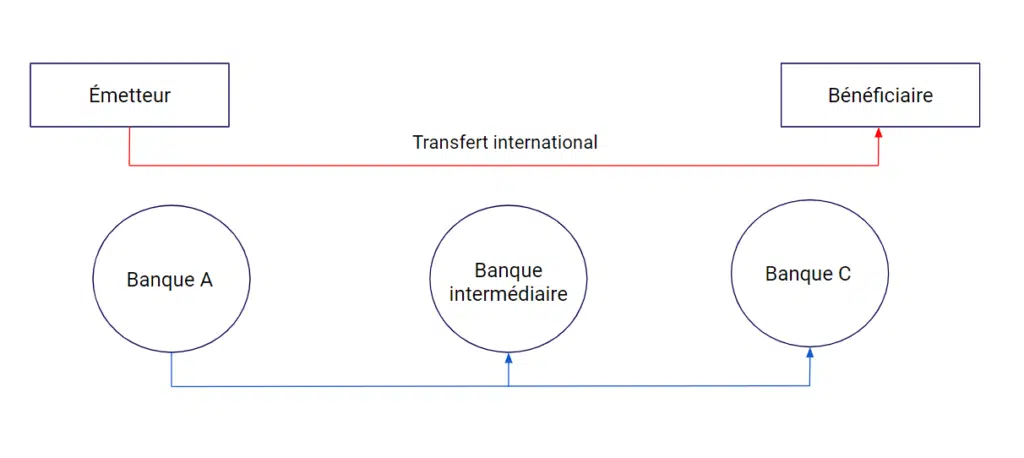
Setting up this type of payment involves fees charged by the financial institutions handling the transaction. These fees can be substantial and should be taken into account before making any payment.
These fees are generally made up of administration and processing charges and, unfortunately, can very rarely be predicted before a transaction takes place. To manage these fees, banks and financial institutions have introduced standardised payment and cost schemes. These schemes determine whether the sender or the beneficiary is responsible for the fees relating to the transfer.
These administration and processing fees typically range from a few francs to several dozen francs, for example for a transfer to the United States.
There are currently 3 main fee schemes: OUR, BEN and SHA. Each of these 3 schemes has its own specific features and advantages.
The 3 cost schemes:
To explain the terms of each of these three options, we will refer back to the diagram at the top of the page.
SHA: Share, or shared fees
This is the default scheme used when processing a financial transaction. It splits the fees between the sender and the beneficiary, as follows:
- Fees relating to the sender’s bank (Bank A) are borne by the sender.
- Fees relating to the intermediary bank and the beneficiary’s bank (Bank C) remain payable by the beneficiary.
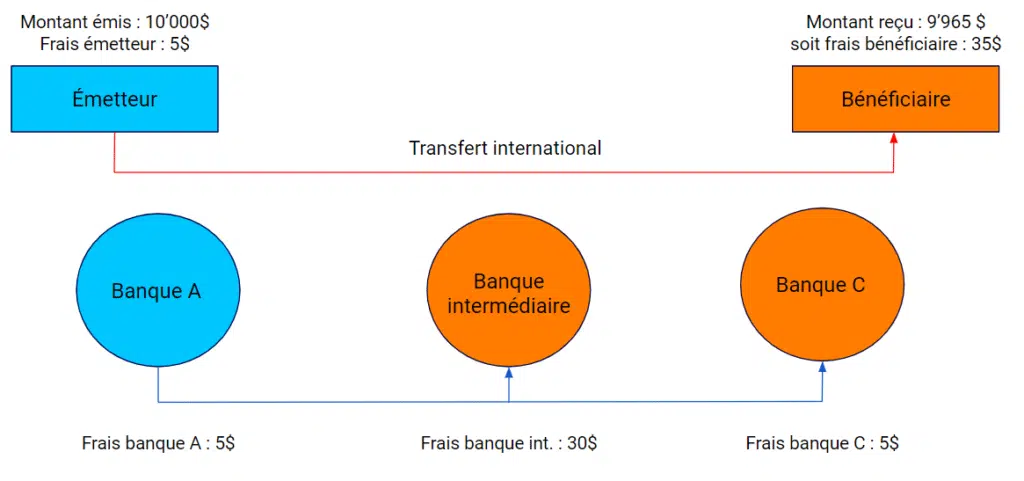
Please note that when paying under this scheme, your beneficiary is likely to receive a lower amount than the one you sent. It is therefore important to specify the scheme used when settling an invoice.
This is particularly important when paying an invoice to China or the United States, as intermediary banks will inevitably charge for their services.
OUR: Our, or fees borne by the sender
This scheme is far more specific and much less common, but it guarantees that the beneficiary receives the exact amount sent by the sender. Under this scheme, the sender bears all the fees relating to the transaction, so the beneficiary has nothing to pay and receives the full amount sent.
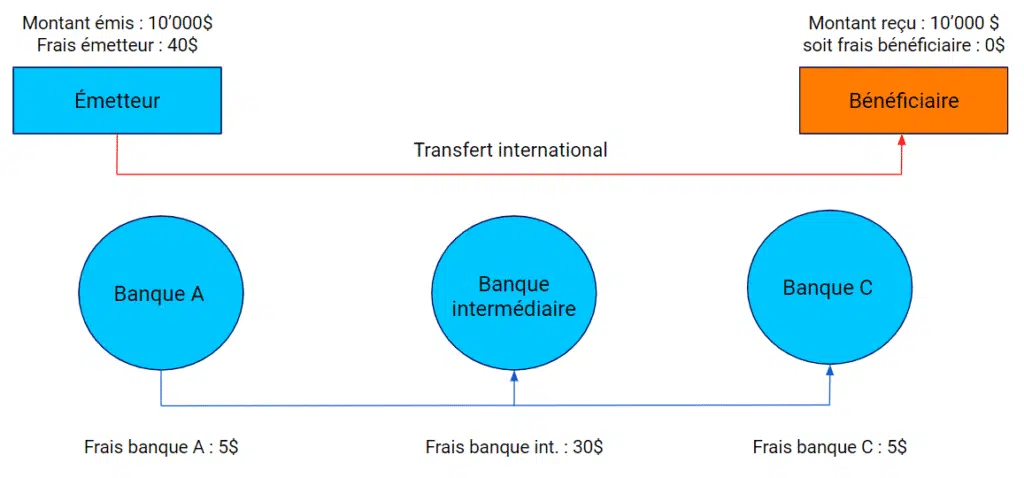
As fees are unpredictable, financial institutions tend to charge a flat rate to cover the full cost. This usually amounts to around thirty francs and is a very specific option, mainly used by businesses.
As this scheme is not used by default, feel free to ask your financial intermediary whether it is the one you need.
BEN: Beneficiary, or fees borne by the beneficiary
This scheme is almost never used. It is often costly for the beneficiary and therefore does not address the challenges of paying an invoice. However, it can be useful when it is impossible to determine the exact cost of a transaction, or under certain types of contracts.
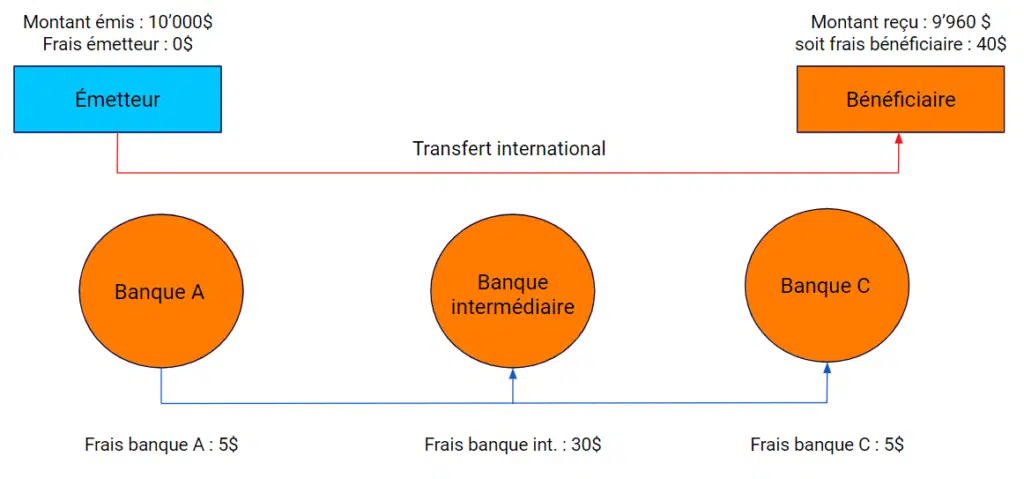
Under this scheme, all costs relating to the transaction are borne by the beneficiary. As a result, the sender knows exactly how much will be debited, whereas the beneficiary can be certain of receiving less than the amount sent. This is useful when there is no contractual constraint and you want to pay a precise amount, regardless of the amount the beneficiary ultimately receives.
So what about b-sharpe?
As part of our offering that lets you pay your international suppliers directly, b-sharpe is able to offer you all three of these cost schemes.
Like other financial institutions, we use the SHA scheme by default, free of charge.
At your request, when quoting the rate for settling your invoice, we can use the OUR scheme and therefore cover the full transfer fees. This scheme costs CHF 28.
The BEN scheme, although less commonly used, remains available and is entirely free of charge.
Conclusion
The cost scheme is therefore a key element in signing and managing a commercial contract involving international financial exchanges. Each of these three solutions is sound, with its own advantages and drawbacks. As part of our activity, we offer all three methods depending on your needs and the constraints governing your international contracts. Feel free to contact us for advice on the best solution for your transactions. Our teams will be glad to give you the guidance you need to carry out your transaction successfully.
What are IBAN and BIC? How do they work?IBAN stands for International Bank Account Number. It is therefore an international standard for structuring bank account numbers that enables the complete, consistent and unique identification of a bank account, regardless of the country or the bank where the account is held.
This system has only existed since 1997 and is now used in around fifty countries worldwide
BIC stands for Business Identifier Code. This is also a standard, defining a universal identification code for banking institutions. Every bank registered with the SWIFT system has a unique BIC code.
These two elements work together to carry out a financial transaction successfully, quickly, securely, reliably and in a traceable way.
What are the structuring rules for IBAN and BIC? What elements do these two codes contain?
The structure of an IBAN is standardised.
The length of an IBAN varies depending on the country where the bank account is held. It ranges from 14 to 34 characters. A Swiss IBAN, for example, has 21 characters, compared with 27 for a French IBAN or 22 for a German IBAN.
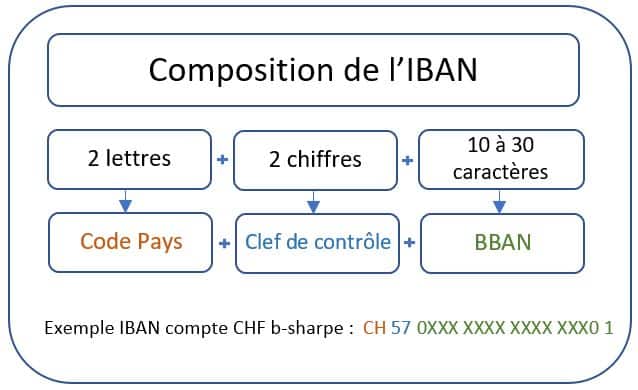
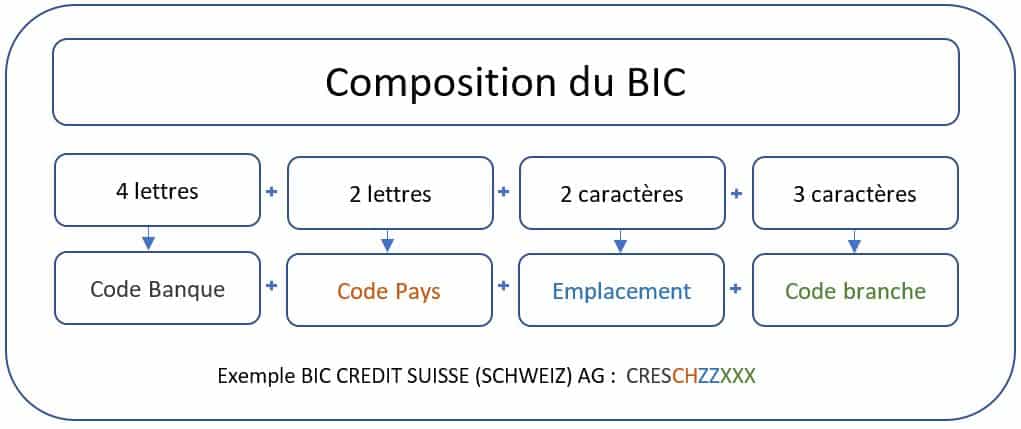
The structure of an IBAN is standardised, although additional information may be included. Since every IBAN specifies the country, the bank and the target account, it is therefore unique.
Depending on the country, the IBAN may include additional information. In France, for example, it is possible to identify the branch where a bank account is held.
The structure of a BIC is also standardised.
A BIC, on the other hand, has a perfectly standard length, which does not vary at all depending on the country where the account is held or the bank.
However, it is common for a bank to provide a BIC code without the branch code, since the latter only indicates a geographical detail and can generally be replaced by ‘XXX’ or even omitted.
How do you check an IBAN?
At b-sharpe, we always check the IBAN you enter in your customer portal. There are also many websites that let you check or calculate the IBAN of a supplier or one of your customers.
We recommend using IBAN Calculator, for example. This website offers broad coverage and good reliability for checking IBANs.
Where can you find our IBANs?
Our transfer IBANs are available directly in your customer portal, under the ‘b-sharpe bank accounts’ section. We have prepared a guide to help you find the IBANs in your customer portal.
Difference and similarity with the RIB
The RIB, or Relevé d’identité bancaire, is the document provided by the bank summarising all the information relating to your bank account. It usually includes not only your IBAN and BIC, but also your surname, first name and address, as well as your account number and the name and address of the bank.
To carry out a transaction, only the IBAN, the BIC, the beneficiary’s name and address are required. All other information is purely supplementary.