


The keys to domiciling your company on Swiss soil
- Why domicile a business in Switzerland?
- What does domiciling a company mean?
- Simple domiciliation vs. domiciliation with fiduciary services
- How do you domicile your company in Switzerland?
- Why domicile your company in Switzerland?
- The different ways to domicile your company in Switzerland
- Using a domiciliation company
- Where should you domicile your company in Switzerland? Focus on Geneva
- Frequently asked questions about domiciling a company in Switzerland
Domiciling your company is an administrative requirement. In practice, it simply means setting the legal address of the registered office. It's often a strategic choice for the director, since this address isn't necessarily the one where you actually carry out your business.
• Start-up, holding company, foreign company or sole trader: domiciliation in Switzerland is open to any profile wanting to benefit from the Swiss framework.
• A simple written agreement with a fiduciary is enough to set your registered office — no capital to deposit, no notary required for this step.
• One key point not to overlook: since 2015, at least one board member must be resident in Switzerland, which the fiduciary can arrange for you.

- Why domicile a business in Switzerland?
- What does domiciling a company mean?
- Simple domiciliation vs. domiciliation with fiduciary services
- How do you domicile your company in Switzerland?
- Why domicile your company in Switzerland?
- The different ways to domicile your company in Switzerland
- Using a domiciliation company
- Where should you domicile your company in Switzerland? Focus on Geneva
- Frequently asked questions about domiciling a company in Switzerland
Why domicile a business in Switzerland?
The problem is that it’s hard to secure a commercial lease in Switzerland, or even a flat. Demand far outstrips supply, and the guarantees required often hold young businesses back.
According to a 2021 survey of tenants, 72% of Swiss households (34% “very difficult” and 38% “fairly difficult”) struggled to find affordable housing in their last search.
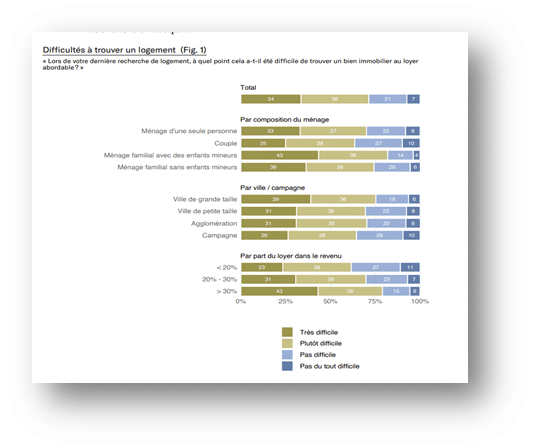
Source: results of the tenant survey commissioned by the Swiss Tenants’ Association
Commercial property is under similar pressure, and access to quality space comes at a cost*.
At b-sharpe, we understand the challenges of living between two currencies and the importance of transparency and professionalism.
This guide is here to help you shake off administrative constraints.
In this article, find out how to get a prestige address, simplify your administrative steps, and benefit from Switzerland’s competitive tax environment.
Let’s take a look at the practical options available to your business…
* (Source: Wüest Partner)
What does domiciling a company mean?
Domiciling a company means establishing its registered administrative and tax address.
Choosing this geographic location matters not just for image, but above all because it determines the applicable legal, administrative and tax rules, whether set by Switzerland’s major institutions, or by foreign ones.
The company must comply with the rules of the place where it is domiciled.
Domiciliation is therefore usually the first step when setting up a company. Whether it’s…
- a corporation,
- a sole proprietorship,
- or a microenterprise.
💡 Good to know :
In France, domiciliation is mandatory for all types of company, including associations.
Simple domiciliation vs. domiciliation with fiduciary services
In practice, you have several options when choosing a domiciliation service
Domiciliation through a company specialising in Switzerland can go well beyond a simple address.
To simplify things for you, providers of these services offer a range of useful extras.
- Receiving and forwarding your mail.
- Access to premises and IT equipment (meeting rooms, for example).
- A phone answering service, so you never miss a call.
In short: if all you need is an address and mail management, a basic package may be enough.
But if you want full logistical support, or want a fiduciary firm to manage your affairs for you, opt for the package with added services.
How do you domicile your company in Switzerland?
The first step before setting up your company in Switzerland? Choosing a legal structure!
As you’ve probably already gathered, choosing a domiciliation company is a particularly strategic decision.
It doesn’t just formalise your registered office address — above all, it sets the operating framework for your business.
But how is this arrangement formalised in practice?
The key step in this solution is signing a domiciliation agreement between the fiduciary and the domiciled company (yours).
The legal steps for an LLC or a corporation
Switzerland offers plenty of flexibility, but for formal structures such as an LLC (Sàrl/GmbH) or a corporation (SA/AG), legal formalities remain necessary.
- The legal framework of the agreement
Company domiciliation is not as tightly regulated in Switzerland as it is elsewhere. Signing a written agreement with the domiciliation company therefore becomes the legal basis for your registered address. - Statutory formalities for corporate entities
Any decision affecting your company’s official address, and above all a transfer of the registered office to a new municipality (i.e. a different canton), is a significant undertaking for an LLC or a corporation.
- You must formally amend your company’s articles of association to record the new address.
- This statutory update generally requires the involvement of a notary to be valid.
- You must then notify the commercial registries of the cantons concerned of this formal change.
⚠️ Please note : A simple change of address within the same municipality is a lighter formality that doesn’t require an amendment to the articles of association.
Required documents and contracts
The documents required depend on the option you choose.
As mentioned above, the domiciliation agreement is the key document for working with a fiduciary.
- The domiciliation agreement (for a fiduciary solution)
This agreement clearly sets out the rights and obligations of each party. Its content must include essential information about both parties:
- About the domiciliation provider (fiduciary): its capital, registered office, and the identity of its legal representative.
- About the domiciled company: its name, legal representative, phone number, identity, and so on.
The agreement must also explicitly set out the services provided, the corresponding fees, and the terms of the arrangement. - Finally, it must specify the start date of the mandate and its duration (fixed-term or open-ended).
- About the domiciliation provider (fiduciary): its capital, registered office, and the identity of its legal representative.
- Other required documents
- If you choose to domicile your company at your home address, you’ll need to provide a proof of domicile.
- For an LLC or corporation relocating its registered office, the key document to provide is the updated and notarised version of your articles of association.
- If you choose to domicile your company at your home address, you’ll need to provide a proof of domicile.
Why domicile your company in Switzerland?
Domiciling your registered office in Switzerland is much more than an administrative formality: it’s a strategic decision that gives your company a significant competitive edge.
Every year the country attracts thousands of entrepreneurs drawn by a genuinely growth-friendly environment.
An attractive tax and economic environment
Choosing Switzerland for your registered office means joining an environment marked by stability and direct tax advantages:
Rock-solid stability
The Swiss Confederation is renowned worldwide for its remarkable political and monetary stability.
Even amid international economic swings, this consistent environment gives your company security and a solid foundation for growth.
Competitive taxation
You benefit from a competitive tax system and a transparent structure. Corporate tax rates are particularly attractive compared with many European countries.
The cantonal factor
This tax advantage is further reinforced by federalism.
Each canton sets its own profit tax rates. It’s therefore worth comparing the rates offered by different cantons to maximise your financial growth right from the moment you register with the commercial registry.
Strengthen your company’s image and credibility
Your registered office address is a powerful marketing and trust-building tool.
Being domiciled in Switzerland is, in itself, a sign of prestige and seriousness.
Business partners, investors and clients around the world immediately perceive Switzerland as a trustworthy location.
This reputation strengthens your company’s credibility on the international market.
It also gives you privileged access to a worldwide business network, significantly easing trade, especially if your business already targets international markets.
Beyond the tax dimension, your choice of canton should also align with your strategic goals.
Some cantons specialise in particular key sectors (finance, technology, watchmaking). Setting up there lets you align your location with regional economic strengths.
And there’s more…
The benefits of domiciling in Switzerland aren’t purely macroeconomic.
With a domiciliation company, you also get access to logistical and administrative services.
This makes day-to-day management of your business considerably easier.
Mail management and registered office
Domiciliation through a professional provider solves the issue of a legal address and ensures smooth administration:
- You get a prestige address: your registered office can be set up at a reputable address.
In a historic or business district such as Geneva’s Old Town (this address is accepted by all Swiss authorities, including the commercial registry).
- You simplify incoming mail: you benefit from smart mail management. The provider takes care of receiving and sorting your mail, filtering out unwanted junk mail.
Arrival notifications come instantly by text message, or mail is scanned and forwarded to you by email straight away. That way, you’ll never miss an official document.
Support with the commercial registry: when setting up or relocating, the domiciliation company prepares the necessary support to register the address change with the commercial registry, simplifying your legal steps.
Access to physical or virtual office space
The domiciliation offer is flexible, allowing you to combine a legal presence with logistical optimisation:
- Virtual optimisation: domiciliation provides the required administrative and tax registered office without tying you into renting expensive, permanent office space. Mail management services via scanning and email forwarding are at the heart of this virtual solution, ideal for lean structures (holding companies, start-ups or dormant companies).
- Online visibility: domiciliation sometimes even includes permission to use the address for your Google Business Profile, strengthening your online presence and professional credibility.
Expert accounting and tax support
Domiciliation often comes with direct access to essential fiduciary and tax expertise:
- Tax optimisation: by domiciling your company with a fiduciary, you gain access to a certified accountant and specialist tax experts.
Their support is invaluable, ensuring your tax return isn’t just correctly filed, but above all fully optimised under cantonal rules.
- Time savings and peace of mind: delegating responsibility for tax administration to an expert (tax return, extension requests, estimating future taxation) ensures full compliance and saves you valuable time.
- Professional expertise and legal compliance: for a corporation or LLC, the provider can offer a fiduciary board mandate.
Appointing a certified accountant as a board member, for example, guarantees professional expertise in company law, accounting and tax matters.
This is the solution for non-resident shareholders looking to meet the legal requirement of having a Switzerland-resident board member while preserving their anonymity.
💡 Good to know :
Since 1 July 2015, the law has required that at least one board member be resident in Switzerland (Art. 718 para. 4 CO).
This requirement ensures both local legal accountability and direct administrative reachability.
Domiciling your company in Switzerland: who is it for?
Domiciliation in Switzerland isn’t limited to large companies.
It’s open to a wide range of entrepreneurs looking to enhance their business and benefit from what Switzerland has to offer.
- Companies being set up: new companies, including those still in the incorporation process, can establish their registered office in Switzerland.
- Recently established companies: young companies benefit from this option too.
- Holding companies: this type of structure frequently opts for domiciliation on Swiss soil.
- All companies: in principle, any company wanting to both enhance its business and benefit from Swiss standards can obtain a Swiss administrative and tax address.
Several concrete options are open to you for establishing your company’s registered office on Swiss soil:
The different ways to domicile your company in Switzerland
This is also the ideal solution for getting a secure address, ensuring mail is sorted and forwarded, and benefiting from administrative services (tax, accounting, advisory).
The different ways to domicile your company
| Type of domiciliation | Condition and practical effect | Main benefit / main risk |
|---|---|---|
| Your own premises (offices, workshops) | Your commercial lease must expressly allow domiciliation of a company. | Classic solution, but requires a dedicated commercial lease. |
| Your home (or a third party’s) | You must be resident in Switzerland and provide proof of domicile. Check whether your lease or condominium rules allow it. If it’s a third party’s home, they must show it is their main residence. | Economical solution, but risk of non-compliance with landlord or tenancy rules. |
| Business incubator | Shared premises rented out by the incubator, which can also support you through the company set-up process. | Comprehensive support for setting up, often with shared premises. |
| Domiciliation company (fiduciary) | Signing a simple written domiciliation agreement between the fiduciary and your company. The ideal solution for securing an address with confidence. | All-in-one solution: registered office + services (mail, premises, advisory). More flexible regulation than in France. |
Using a domiciliation company
Working with a specialist company is the most obvious option. It’s simple, and widely chosen.
A simple written domiciliation agreement between the fiduciary (the domiciliation provider) and your company is enough to establish your registered office in Switzerland.
And as briefly mentioned, these companies don’t just offer an address. They also provide:
- Receiving and forwarding your mail. Business mail is sorted and dispatched.
- Access to premises and IT equipment, plus a space for confidential meetings.
- A phone answering service.
- Essential services for running your company: tax, finance, accounting, mandatory filings, advice and support with regulatory matters.
Even though Swiss law doesn’t strictly regulate this service, the domiciliation provider and the domiciled company each have certain obligations. Their respective roles are set out in the domiciliation agreement.
The domiciled company’s obligations
- Notify the domiciliation provider of any change of activity in your company.
- Use the premises provided solely for establishing your registered office.
- Expressly authorise the provider for any receipt made on your behalf.
- Provide your full details for the agreement: company name, legal representative, phone number, identity, etc.
- Comply with all obligations set out in the agreement.
The domiciliation provider’s role
- Register the premises with the business register or the commercial registry.
- Keep a register of all premises linked to the domiciliation of the companies it hosts.
- Provide suitable premises to uphold professional confidentiality.
- Manage and guarantee both parties’ rights and obligations under the agreement.
- Deliver the agreed services (mail management, premises, etc.).
Where should you domicile your company in Switzerland? Focus on Geneva
Choosing where to set up your registered office has a direct and substantial impact on your company’s profitability, particularly through taxation.
The tax criterion
Before settling on a canton, it’s essential to analyse the total tax burden on profits.
In Switzerland, tax is levied at three levels: federal, cantonal and municipal.
Cantonal tax alone varies enormously, ranging from 3.3% to 12.5% across the 26 cantons (source: NewCo).
Depending on where you set up, your company’s profit tax rate can range from 9% to 25%. That’s a significant difference, and it calls for careful analysis, for example using an online calculator.
The strategic approach is to favour a location where your company can grow without unnecessary friction. It’s often advisable to avoid sectors where competition is already strong and well-established.
Geneva: an international financial hub
French-speaking Switzerland, with the cantons of Geneva and Vaud, positions itself as a major draw.
Geneva is known worldwide as an international financial centre with a high concentration of multinational companies.
For reference, the profit tax rate in Geneva is 14.00%.
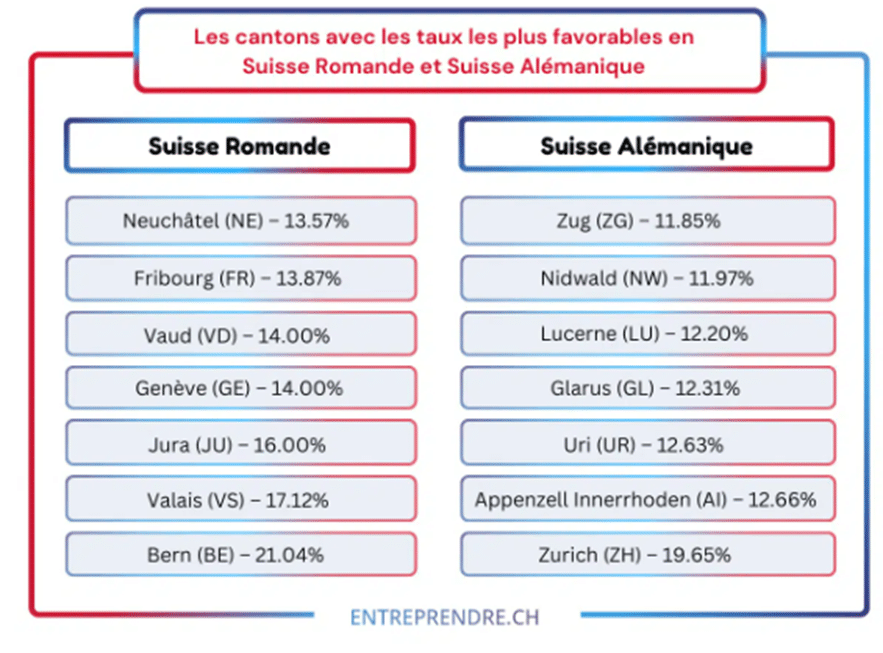
Source: ENTREPRENDRE.CH
If you choose Geneva, several domiciliation providers there offer flexible, cost-effective and immediately available solutions for setting up your registered office.
- Prestige address: you get a reputable business address.
- Accessibility and transparency: rates start at very competitive levels (such as CHF 29/month).
Offers with no commitment, no notice period and no admin fees.
Key takeaways :
Domiciling your company in Switzerland is a powerful lever for growth and credibility. You benefit from a stable tax environment and a strong international brand image.
So don’t let logistical constraints hold back your expansion.
Reach out, for example, to a fiduciary firm specialising in Geneva to bring your project to life.
And remember to use our services whenever you need to make a payment or transfer in euros or Swiss francs.
Secure your company’s compliance and future today.
Frequently asked questions about domiciling a company in Switzerland
Rates are competitive and start at around CHF 29 excl. VAT per month for basic packages.
The exact price depends on the package chosen.
You often benefit from great flexibility: no commitment, no notice period, and no admin fees.
Annual billing can generate savings (up to 25%).
Tax:
Your company is subject to VAT once its annual turnover exceeds CHF 100,000.
Being VAT-registered lets you reclaim VAT on your business purchases.
Social security:
Registering with AHV/AVS is mandatory from the moment you start operating.
Mandatory contributions (AHV/IV/EO or AVS/AI/APG) are split between the company (as employer) and the employee for an LLC or corporation.
In practice:
Domiciliation gives you direct access to fiduciary services.
Full incorporation is the process that establishes your legal structure (LLC, corporation, etc.). It’s mandatory before you can start operating and requires minimum share capital (e.g. CHF 20,000 for an LLC).
Domiciliation, on the other hand, is about establishing the company’s administrative and tax address.
It’s necessary for incorporation, but can also be used on its own simply to obtain a prestige address.
Fiduciary firms often offer complete support for incorporation (from CHF 490, notary fees included) bundled with the domiciliation service, which simplifies the start-up process.
On the same topic