


What are IBAN and BIC? How do they work?
Before we start breaking down what an IBAN and a BIC consist of, it is important to understand what they are.
• The IBAN uniquely identifies a bank account internationally, with a length that varies by country (21 characters in Switzerland, 27 in France).
• The BIC universally identifies a bank registered on the SWIFT network, with a standardised length regardless of country.
• b-sharpe systematically checks the IBAN entered by clients to ensure the reliability and security of every transaction.

IBAN stands for International Bank Account Number. It is therefore an international standard for structuring bank account numbers that enables the complete, consistent and unique identification of a bank account, regardless of the country or the bank where the account is held.
This system has only existed since 1997 and is now used in around fifty countries worldwide
BIC stands for Business Identifier Code. This is also a standard, defining a universal identification code for banking institutions. Every bank registered with the SWIFT system has a unique BIC code.
These two elements work together to carry out a financial transaction successfully, quickly, securely, reliably and in a traceable way.
What are the structuring rules for IBAN and BIC? What elements do these two codes contain?
The structure of an IBAN is standardised.
The length of an IBAN varies depending on the country where the bank account is held. It ranges from 14 to 34 characters. A Swiss IBAN, for example, has 21 characters, compared with 27 for a French IBAN or 22 for a German IBAN.
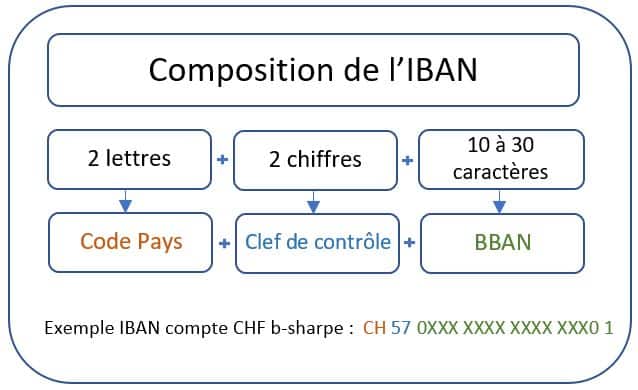
The structure of an IBAN is standardised, although additional information may be included. Since every IBAN specifies the country, the bank and the target account, it is therefore unique.
Depending on the country, the IBAN may include additional information. In France, for example, it is possible to identify the branch where a bank account is held.
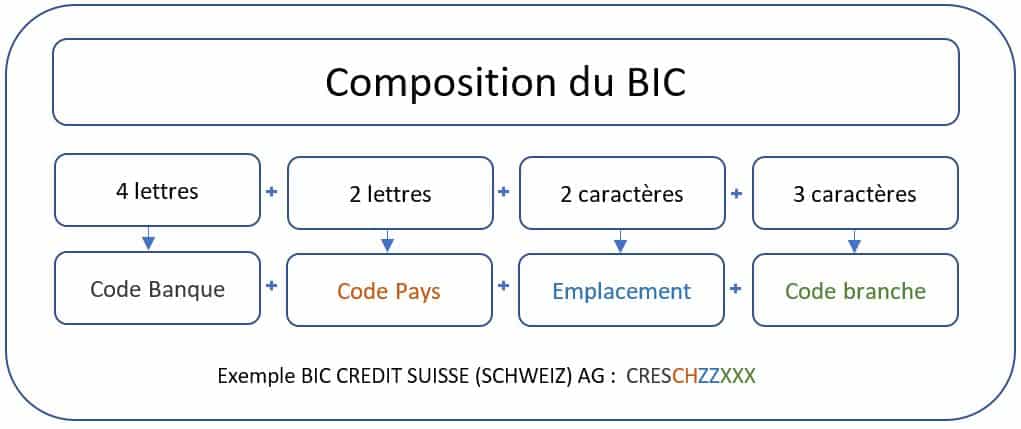
The structure of a BIC is also standardised.
A BIC, on the other hand, has a perfectly standard length, which does not vary at all depending on the country where the account is held or the bank.
However, it is common for a bank to provide a BIC code without the branch code, since the latter only indicates a geographical detail and can generally be replaced by ‘XXX’ or even omitted.
How do you check an IBAN?
At b-sharpe, we always check the IBAN you enter in your customer portal. There are also many websites that let you check or calculate the IBAN of a supplier or one of your customers.
We recommend using IBAN Calculator, for example. This website offers broad coverage and good reliability for checking IBANs.
Where can you find our IBANs?
Our transfer IBANs are available directly in your customer portal, under the ‘b-sharpe bank accounts’ section. We have prepared a guide to help you find the IBANs in your customer portal.
Difference and similarity with the RIB
The RIB, or Relevé d’identité bancaire, is the document provided by the bank summarising all the information relating to your bank account. It usually includes not only your IBAN and BIC, but also your surname, first name and address, as well as your account number and the name and address of the bank.
To carry out a transaction, only the IBAN, the BIC, the beneficiary’s name and address are required. All other information is purely supplementary.