
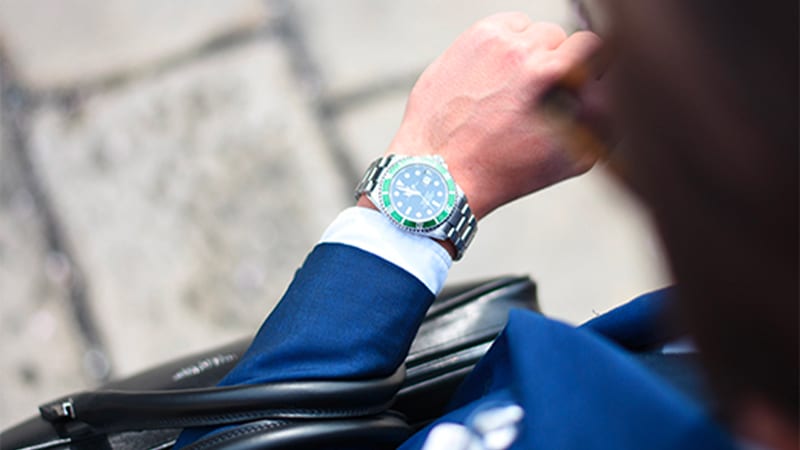

Switzerland: the home of watchmaking
Although watchmaking accounts for only a small proportion of Swiss exports, it is seen as a symbol of ‘Made in Switzerland’ craftsmanship and excellence. The world’s leading watchmakers were founded here and continue to inspire admiration today with their precision. But why Switzerland?
• Swiss watchmaking has its roots in Geneva from 1541, with the world's first watchmakers' guild founded there in 1601.
• The "établissage" system, invented by Daniel Jeanrichard, allowed craftsmen to specialise and massively increased Swiss watch production.
• The great houses still iconic today (Blancpain, Patek Philippe, Audemars Piguet...) emerged in the 19th century, and the second-hand market has seen remarkable growth in recent years.

1. The history of watchmaking in Switzerland
As you might imagine, watchmaking didn’t originate in Switzerland – it goes back much further than that! In fact, the first sundials appeared around 1450 BC among the Egyptians, who measured time by observing the cycle of day and night.
It was not until 1541, when John Calvin banned all displays of wealth and ornamental objects, that goldsmiths and jewellers—who already enjoyed a fine reputation abroad—turned their attention to watchmaking.
If there are two names to remember, they are Jean Petitot and Jean-Etienne Liotard, who went on to become outstanding ambassadors for Geneva’s watchmaking expertise.
Such was its success at that time that the world’s very first watchmakers’ guild was founded in Geneva in 1601 under the name ‘Maîtrise des horlogers de Genève’.
In the 1700s, there were so many watchmakers in Geneva and competition between them was so fierce that many craftsmen chose to set up shop in other Swiss towns such as Lausanne, Neuchâtel, La Chaux-de-Fonds, the Joux Valley and Biel.
It was during this period that the goldsmith Daniel Jeanrichard introduced the division of labour system, which allowed tasks to be distributed amongst several craftsmen, each of whom then specialised in the manufacture of a specific component of the watches. It was largely thanks to this innovation that production and exports continued to grow.
In 1770, the precursor to the automatic watch we know today made its appearance: the “shaking” watch, conceived and created by Abraham-Louis Perrelet.
It was not until the 19th century that many of the watchmaking houses that remain iconic today were founded, including:
- Blancpain, which, according to our sources, is said to be the oldest Swiss watch brand.
- Patek Philippe, which made its name with the invention of the self-winding watch
- Baume & Mercier
- Audemars Piguet
And many more…
The year 1967 marked a turning point in the world of watchmaking with the development, by the Neuchâtel Electronic Watch Centre, of the world’s first quartz wristwatch, the famous Beta 21.
2. Second-hand watches
In recent years, there has been a growing interest in second-hand watches. With record-breaking auctions and a dramatic surge in online sales, pre-owned models and other collectable pieces are now in high demand and are driving the watch market to new heights.
The health crisis has not spared the sector, as – like many other industries – a large proportion of purchases are made by tourists from all over the world who swear by Swiss excellence. Collectors have therefore stepped in, and today there are more of them than there were just a few years ago. Many of these buyers are on the lookout for rare and unusual pieces that they can keep safe, display or resell.
The second-hand market, and the watch market in particular, also offers financial benefits. It is an excellent way to do business, as some watches are sold for 40% to 50% less than the retail price – a significant saving when it comes to luxury items.
According to a study conducted by Deloitte in 2021, nearly one in three consumers say they are willing to buy a pre-owned watch in the next 12 months. Many jewellers and watch retailers have therefore jumped at the chance!
3. Swiss watchmaking around the world
Did you know that Switzerland produces just over 15 million watches a year? It accounts for more than 50% of the global watch market by value, with an estimated turnover of over 50 billion Swiss francs across all brands.
When it comes to the mid-range and high-end markets, no other country comes close to Switzerland. In fact, over 95% of watches sold for more than CHF 1,000 are produced in our beautiful country. If we take recent years as an example, the average value of Swiss watches exported has risen steadily to reach CHF 1,200 today – a figure that must obviously be multiplied by two or even three in some cases to arrive at the price actually paid by the end customer.
The country is home to more than 350 brands bearing the ‘Swiss Made’ label, though not all of them are in the same league. The five most powerful brands alone account for 50% of the watch market. Behind the unrivalled Rolex, we find:
- Omega (Swatch Group)
- Cartier (Richemont)
- Longines (Swatch Group)
- Patek Philippe
- Audemars Piguet
It is therefore clear that, alongside independent brands, three major groups dominate the Swiss watch market:
- Swatch Group
- Richemont
- LVMH
However, watchmaking is not Switzerland’s main economic driver. It accounts for just 1.5% of GDP and ranks third among export industries, behind the pharmaceutical and chemical sectors and the machine tool sector.